Why the ---- is my company so slow?
Eliminate organizational drag by modernizing your Operating Models for faster, high-authority decision-making.
Organizational drag is typically caused by high-pressure environments that prioritize compliance over problem-solving. VEGA loops diagnose these bottlenecks by measuring the gap between tactical and adaptive performance. This AI-Native & People-First approach rebuilds velocity by decentralizing authority and establishing high-frequency feedback loops that eliminate bureaucratic friction.


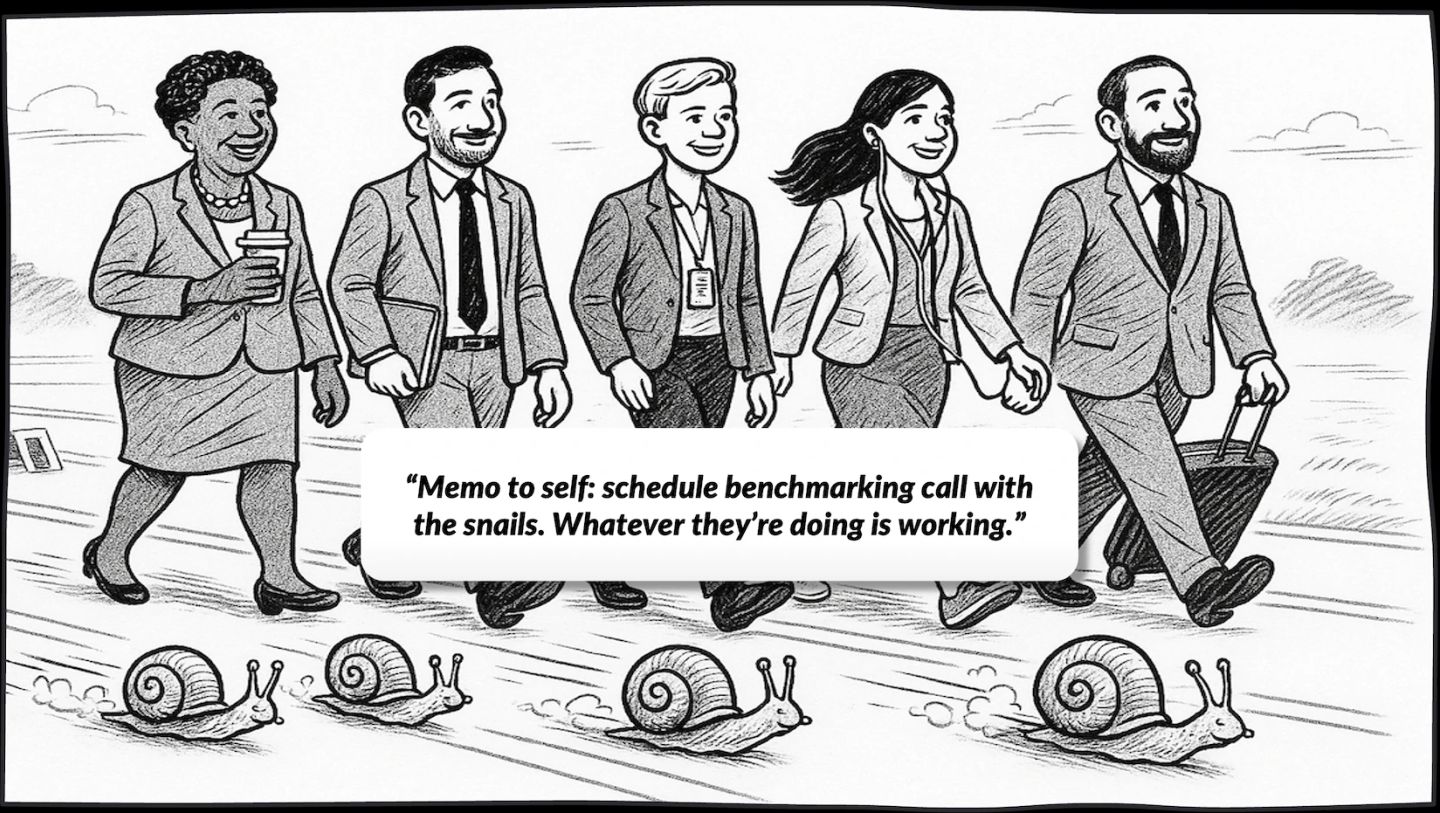
At a recent offsite, a CEO said to me: "Our company is like a slow-moving bus full of frantic kids – lots of energy and movement inside, but the bus itself is barely inching along."
This sentiment is all too common. In just the last few weeks, we heard executives and CEOs describe this as:
- "My people lack urgency".
- "People in my company seem complacent."
- "There's no intensity in my company."
Leaders today often face an infuriating paradox: all their employees seem busy AND the organization is moving too slowly.
Is the issue your people, or is the issue your management system and ways of working?
Answer these 8 questions as an executive team to figure out if your management system needs changing before you fire everyone.
Understanding the VEGA Loop: the engine of knowledge work
Imagine you're driving a car down a winding road. Imagine on both sides are dangerous cliffs. Now imagine you can only touch the steering wheel once every ten minutes? How fast will you drive the car? What if you were blindfolded?
This simple story is one that shows up across machines, people, teams, and companies. Namely, an organization's speed is a function of the frequency and quality of its feedback loops.
When you cannot see or course-correct, the feedback loop isn't effective.
In today's complex companies, there are a few feedback loops that matter.
Loop 1: The creative, or "figuring it out," loop is where organizations set direction. It involves two steps:
- Visioning: Deciding what problems are most important to solve.
- Exploring: Figuring out how to solve them.
Visioning is collaborative. It requires surfacing together. Exploring is individual. It requires diving alone.

Loop 2: When these two steps result in a direction, companies need to shift to the execution, or "getting it done" loop. This loop also has two steps:
- Galvanizing: Getting ready to execute (resources, structure, process).
- Achieving: Executing and adapting to make progress.

Galvanizing is also surfacing as a team and collective in nature. Achieving is diving, and individual in nature.
Loop 3: Once we've achieved and have a read from the market, we start again with visioning.

Organizations that run these loops quickly and effectively consistently outperform. When these loops break, they succumb to the innovator's dilemma and stop adapting to their changing markets.
In many organizations, these loops are poorly defined and managed. Market-driven feedback is slow, unclear, or non-existent. Teams get stuck in one phase, skip crucial steps, or lack the technology and habits to transition effectively. This friction, lack of feedback, and resulting bureaucracy are major causes of perceived slowness, even when people are trying hard.
The 8-Question Diagnostic: Where is Your System Slowing Down?
The companies that create sustainably high levels of motivation and performance make sure they run the right performance habits in each team, with real accountability. To do so, they operationalize VEGA loops through 8 habits.
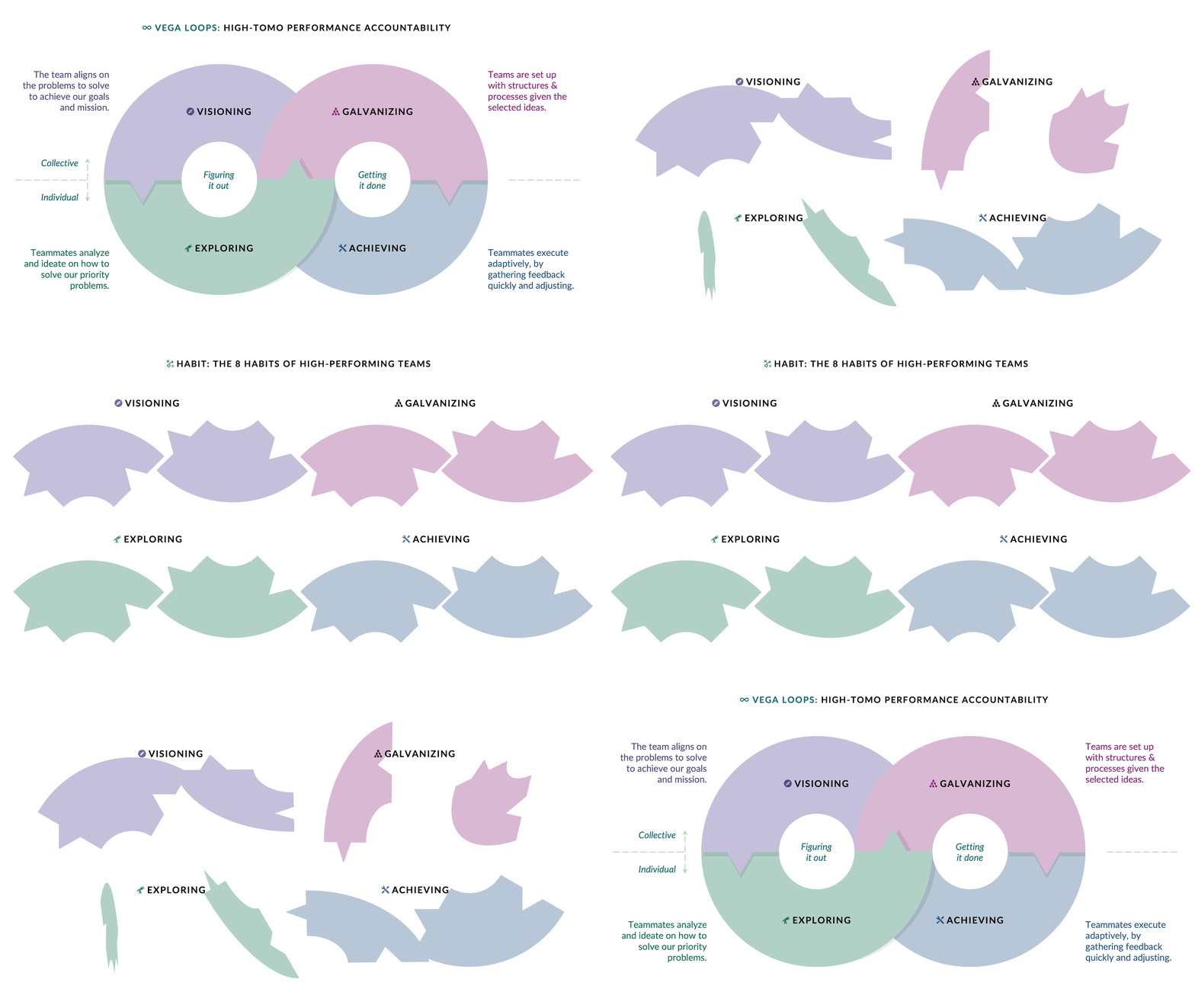
This 8-question diagnostic uses these habits to see what might be making your company slow.
For each question, answer honestly about your team or organization. Give yourself 1 point for a "Yes" (this area supports faster velocity) and 0 points for a "No" (this area is likely contributing to slower velocity). Your total score (out of 8) can indicate the health of your management system.
Visioning - Are we pointed in the right direction?
- Are the organization's vision and strategic priorities clear enough for frontline teams to figure out what they need to do and how to do it?
- Are teams able to make fast, collaborative decisions without getting stuck in analysis paralysis, endless debates, and stall tactics?
Exploring - Do we have good ideas to pursue?
- Is urgency coming from customer or market feedback, versus false deadlines and internally driven pressure?
- Are teams able to experiment and learn quickly from results, rather than being held back by a fear of failure or making the "wrong" decision?
Galvanizing - Are we set up for success?
- Do our organizational structure, resource allocation, and problem-solving processes help teams own their outcomes with minimal cross-team dependencies?
- Do we set, mentor, and maintain the norms of high-productivity performance?
Achieving - Are we making consistent progress?
- Do workstream leaders reflect each week on their priorities to ensure we are heading in the right direction at the right speed?
- Do colleagues have the necessary skills and expertise to effectively solve problems and deliver their intended outcomes?
Scoring your organization's velocity
Tally up your "Yes" answers from the 8 questions. Your score (out of 8) is a rough indicator of how healthy your organizational system is and how well it supports velocity.
- Score 0-2: Your system is likely creating significant drag. These widespread issues are causing significant slowness and potentially leading to frustration and disengagement (like "ghostworking").
- Score 3-5: There are significant areas for improvement in your organizational system. These issues are likely creating noticeable drag and impacting velocity.
- Score 6-8: Your system is likely quite healthy and supports high velocity. Perceived slowness might be isolated incidents or related to external factors.
How to improve your velocity: revamping your cadences
Okay, so you've gone through the 8 questions and maybe you've spotted some areas where your system is slowing things down. That's the first big step – knowing where the drag is happening. The next part is figuring out how to fix it and actually speed things up.
Remember how we talked about velocity being a function of your feedback loops? The best way to improve those loops is by getting your organizational cadence right. Think about the rhythm of how work gets reviewed, discussed, and adjusted across the company.
There are really two main rhythms that matter most for knowledge work:
Your triannual cadence
Your triannual cadences should have three steps where the goal is to create clarity and motivation to execute the right priorities.
The first step is the cascading Strategy Check. The purpose of this cascade is for everyone to leave with clarity on their main growth priority. Some companies call this their "p-zero priority". When done well, teams leave excited with a good set of priorities to drive toward the organization's vision.
The second step is the Culture Check. The best leading indicator we've found to see if a team will execute its strategy well is to see if they are motivated to do so. The Culture Check does this and better still helps the team figure out how to improve.
The third step is the Skill Check. Almost always, teams lack critical skills to fully execute their growth strategies. The Skill Check helps to preemptively agree on the skills each colleague can practice while driving their strategy forward. This helps to build more confidence and less imposter syndrome.
We've found through a lot of experimentation that half yearly cascades are too slow, but quarterly are too fast. Triannual (or every four months) is just right.
The Factor.AI platform provides AI agents to every team to help them execute these cadences in ways that are fun, fast, and freakishly high-performing.
Your weekly cadence
When I was a young manager, I used to hide my and my team's work from my leaders. I wanted to impress them with our work, but I ended up constantly disappointing them and encouraging micromanagement from them.
One day, I told my boss I thought he was a micromanager. He said to me, that as a leader, my job is to keep the whole team on the same page. By not doing so, I'm forcing him to micromanage just to figure out what's going on.
He was right.
From there on, I would write a weekly reflection for my leadership. This included three major sections:
- First - Are we still heading in the right direction, or do we need to pivot, and why?
- Second - Are we moving at the right pace, or do we need to clear blockers, and why?
- Third - What are our very next priorities?
In the operating models we implement we not only require these kinds of Weekly Reflections, but we use Factor's cutting edge AI to help.
- First, if teams have been saving their meeting notes, work product, and transcripts in Factor as they go, the reflections are drafted by AI first.
- Then the leaders of each strategic priority collaborates on their reflection.
- Next everyone gets an agentic AI as a chief of staff that helps them see where priorities are stuck.
Implementing this cadence has never been easier at this point. With a willing executive team, we can drive this change in a way that is turnkey and deeply inspiring for your talent.
At first, we shape our systems. Thereafter, our systems shape us.
Feeling like your organization is moving slowly is a common challenge, especially in today's dynamic environment where high velocity is key to navigating volatility.
However, the root cause is rarely just individual employees "slacking off." More often, it's a signal that the organizational system – the poorly managed VEGA loops and inadequate feedback mechanisms – needs attention.
By using the VEGA framework and asking these 8 diagnostic questions, leaders can shift from potentially blaming individuals to identifying and addressing the systemic issues that are truly creating drag.
Factor.AI's integrated tools – Strategy Checks, Culture Checks, Skill Checks, Weekly Reflections, and Coaching Guides offer practical, built-in ways to implement the VEGA principles, helping you diagnose problems, improve team habits, and ensure effective execution through better feedback loops and cadence.
Use these questions and tools to foster clarity, remove roadblocks, and build an organization that doesn't just work hard, but works smart and fast, achieving true velocity in the face of volatility.
About the authors
Lindsay McGregor
Meet Lindsay McGregor, the best-selling co-author of Primed to Perform, and co-founder of Factor.ai and Vega Factor. She's on a mission to build organizations that are AI Native & People First, because, let's be honest, who wouldn't want a world where every company thrives and everyone genuinely loves their career?
Lindsay is a hard-working nerd at heart. She holds an MBA from Harvard Business School and an undergraduate degree from Princeton University. A former McKinsey & Company consultant, she's also a New York City Library cardholder and a science fiction enthusiast.
Today, Lindsay isn't just talking about change; she's making the tools and doing the science needed to ensure everybody has great professional lives. It's safe to say, she's making work work better for everyone.
Neel Doshi
Meet Neel Doshi, the best-selling co-author of Primed to Perform, and co-founder of Factor.ai and Vega Factor. He's dedicated his career to a pretty ambitious goal: creating a future where all companies are high-performing because they're AI Native & People First. Think of it as making work so good, people actually look forward to Mondays.
Neel looks at this challenge through the eyes of an engineer. He earned his engineering degree from MIT and his MBA from the Wharton School. A former Partner at McKinsey & Company, he's also a Kentucky Colonel and a graduate of the Bronx High School of Science. Neel takes science-nerd to all new heights.
Currently, Neel is focused on showing the world that through science and AI, every team and company can be extremely motivating and high-performing. No one need be left behind in the march of progress.
Further reading
- Should Wells Fargo have fired employees who were simulating keyboard activity?
Wells Fargo's recent firings over "ghostworking" highlight the real issue: not slacking, but a lack of motivating work and clear expectations. Learn why better leadership—not more surveillance—is the answer. - Blame is why your culture is low-performing
Blame-based cultures erode motivation and performance. Discover how to shift from blame to supportive accountability and build a high-performing environment. - How company culture shapes employee motivation
Explore the science of motivation and how culture can make or break it. Learn about the six primary motives for work and how to cultivate a culture that enhances performance. - Org structure might be causing your company's dysfunction
Constant re-orgs and misaligned structures drain motivation and performance. Learn six first principles to design an org structure that supports high performance. - Three ways to build a culture that lets high performers thrive
Most companies focus on controlling low performers, but the best cultures are obsessed with unlocking and retaining high performers. Learn three ways to build a culture where top talent thrives.