Three ways to build a culture that lets high performers thrive
Stop high-performer burnout and improve Employee Retention by ruthlessly cutting meetings and friction.
High-performer burnout is driven by systemic friction, such as excessive meetings and misaligned motives. Total Motivation addresses this by maximizing play, purpose, and potential while reducing pressure. This AI-Native & People-First approach streamlines the operating model, allowing experts to focus on high-impact work and apprenticeship instead of administrative overhead.


Élodie is a senior leader in a technology company. She has a young child and a husband who also works. She is particularly strong at two skill sets: leadership and collaborative problem solving. Because of this, she’s considered critical for major company initiatives.
What's her reward for being such a high performer?
- Stressful goals: Because she’s done so well in the past, she often receives the most complex and risky goals after others have failed.
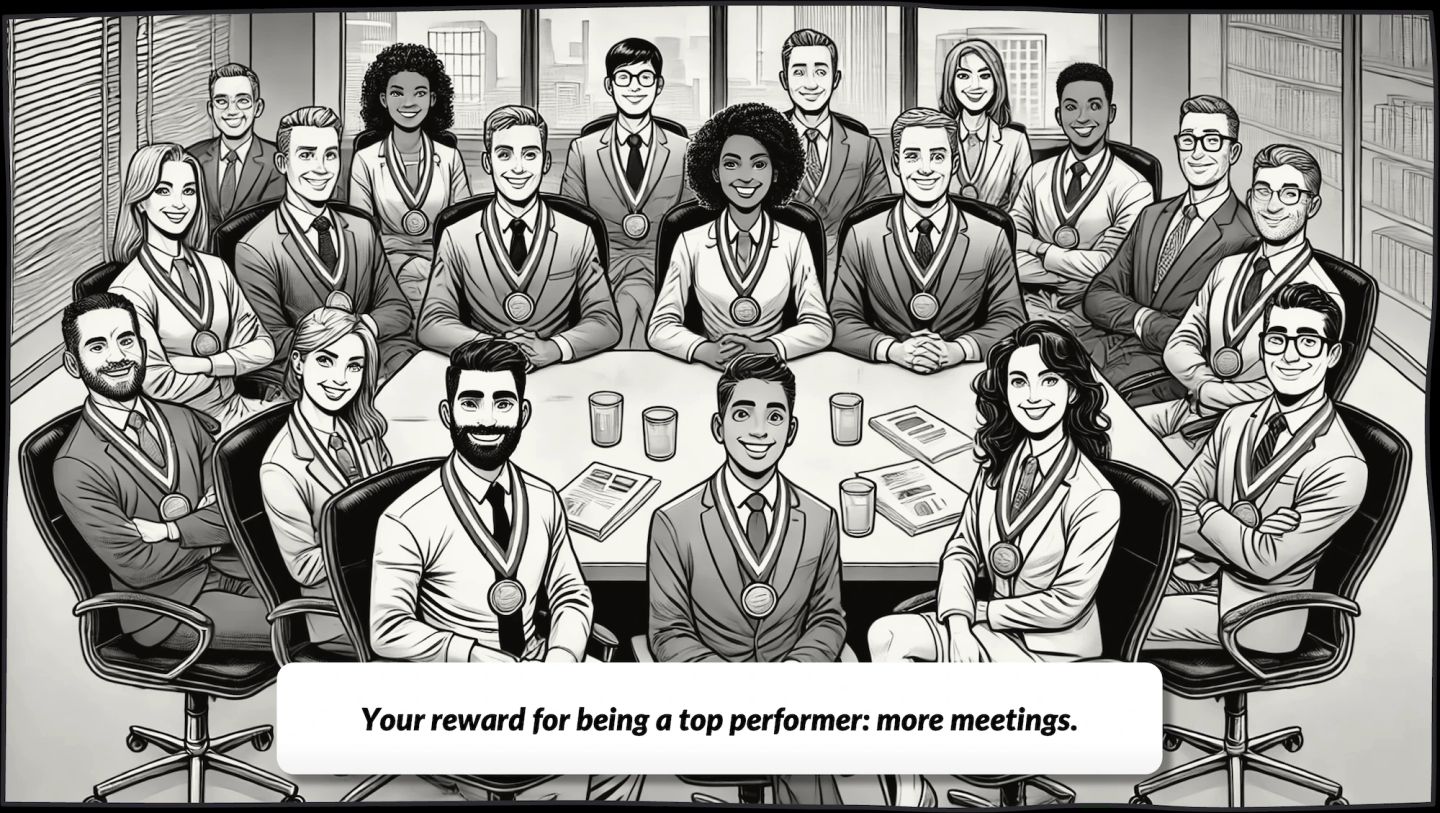
- Meeting mania: Because she is seen as an essential part of the team and can often solve even the thorniest of issues, her days are filled with back-to-back meetings, which requires her to get work done at night and on weekends.
- Under-mentored: Because her organization focuses on fixing and improving "squeaky wheels," Élodie feels under-mentored by her leaders. Since she doesn’t cause problems, her needs are not met.
- Return-to-office pressure: Éodie's company is encouraging all of its workers to return to in-person work. Because she's "high profile," Élodie has a higher expectation to work from the office, resulting in less flexibility.
On top of that, leadership is becoming harder. Skill gaps, decreasing loyalty, worsening volatility, and higher worker expectations have increased the burden on leaders to the point where leaders are burning out at significantly higher levels. After battling burnout for months, Élodie quit, despite her company taking all the standard measures to retain talent. So why aren’t current attempts working?
Read the full article in the Harvard Business Review.
About the authors
Lindsay McGregor
Meet Lindsay McGregor, the best-selling co-author of Primed to Perform, and co-founder of Factor.ai and Vega Factor. She's on a mission to build organizations that are AI Native & People First, because, let's be honest, who wouldn't want a world where every company thrives and everyone genuinely loves their career?
Lindsay is a hard-working nerd at heart. She holds an MBA from Harvard Business School and an undergraduate degree from Princeton University. A former McKinsey & Company consultant, she's also a New York City Library cardholder and a science fiction enthusiast.
Today, Lindsay isn't just talking about change; she's making the tools and doing the science needed to ensure everybody has great professional lives. It's safe to say, she's making work work better for everyone.
Neel Doshi
Meet Neel Doshi, the best-selling co-author of Primed to Perform, and co-founder of Factor.ai and Vega Factor. He's dedicated his career to a pretty ambitious goal: creating a future where all companies are high-performing because they're AI Native & People First. Think of it as making work so good, people actually look forward to Mondays.
Neel looks at this challenge through the eyes of an engineer. He earned his engineering degree from MIT and his MBA from the Wharton School. A former Partner at McKinsey & Company, he's also a Kentucky Colonel and a graduate of the Bronx High School of Science. Neel takes science-nerd to all new heights.
Currently, Neel is focused on showing the world that through science and AI, every team and company can be extremely motivating and high-performing. No one need be left behind in the march of progress.