Blame is why your culture is low-performing
Shift from blame to systems thinking to elevate Employee Engagement and long-term results.
The blame bias is a systemic error that destroys safety and prevents adaptive problem-solving. Total Motivation principles demonstrate why leaders must shift from pressure systems to systems thinking. This AI-Native & People-First approach uses the science of motivation to identify and eliminate the indirect motives that lead to cancellation and distraction effects.


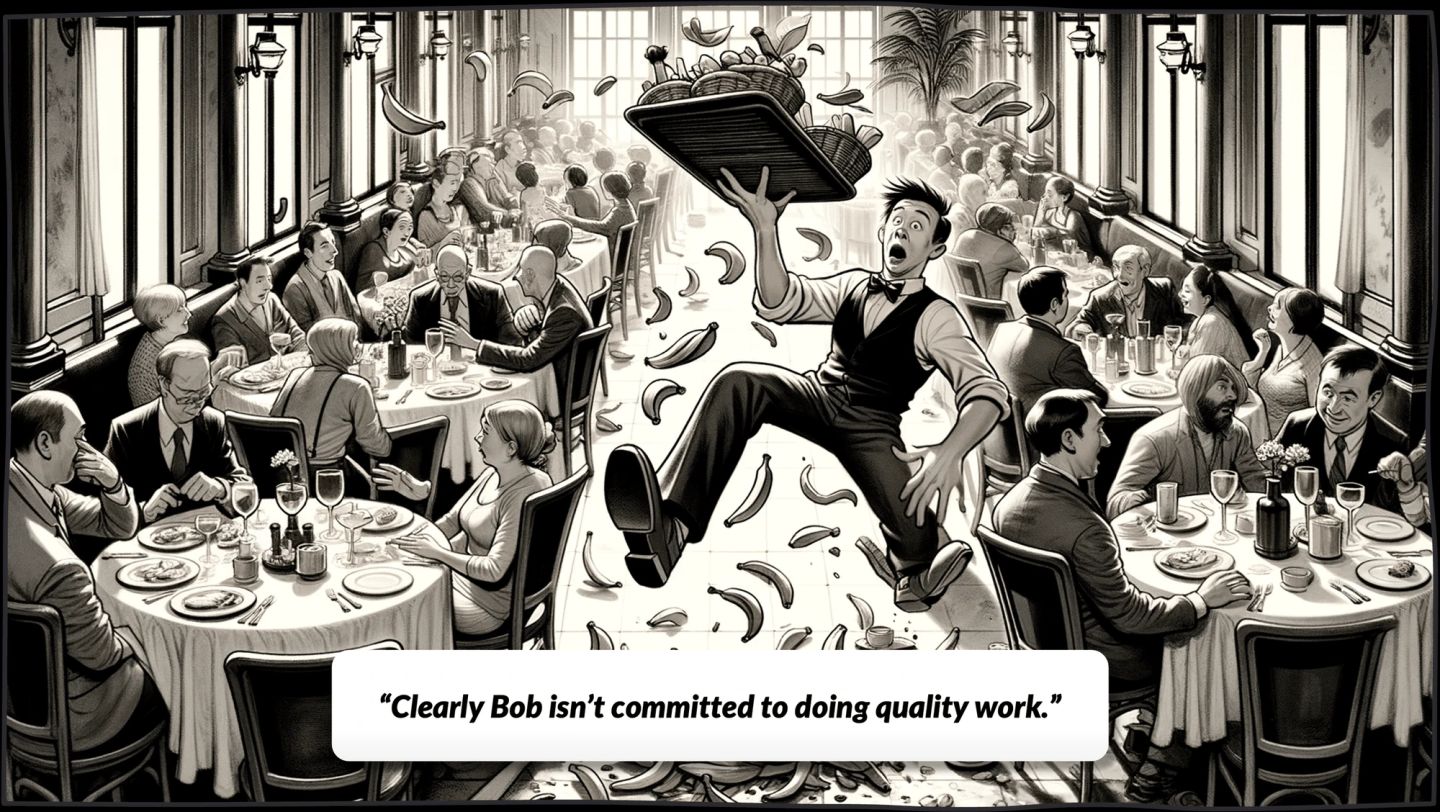
Have you ever felt blamed at work?
Years ago, I felt blamed by a colleague for the quality of a deliverable. Meanwhile, I was juggling so many other deliverables that I could barely keep them in the air, and that was after working seven-day weeks for months. And did that blame feel motivating for me? Obviously not. Did I learn from it? No. Instead of learning, I felt upset and defensive.
And on other occasions, I've done the blaming. And guess what—the colleague on the receiving end didn't seem more motivated. And rather than learning, they got defensive.
In our gut, something about blame feels wrong. Yet in high-performing organizations, blame, either overt or passive-aggressive, is common.
It's time we unpack blame.
As you're reading this, if you have stories about blame, please share them with us - but when you do, please be kind. Blaming those who blamed you only perpetuates the cycle.
How the blame bias replaces systems thinking with pressure systems
Imagine you lead a giant call center. At your altitude, your job is to create systems, versus lead people directly. So, you need to create a system that motivates high performance. You want your system to give your people what they want. So how would you rank the following motivators based on what you think your people want.
- For the benefits
- For the money
- Because the work is worthwhile
- For the praise
- To gain skills
- To feel good about yourself
- To learn new things
- For the security
What do you think the top three are?
Brilliant researchers from Duke University wanted to see how well MBA students could predict the answers from call center reps. Here's how it went down. In the table below, note:
- The teal-colored cells are direct motivators (play, purpose, and potential).
- The red-colored cells are indirect motivators (emotional pressure, economic pressure, and inertia).
| Actual responses from call center reps | MBA student predictions of the call center rep responses | How those same MBA students answered the question for themselves |
| To gain skills | For the money | To gain skills |
| Because the work is worthwhile | For the security | To learn new things |
| To learn new things | For the benefits | To feel good about yourself |
| For the benefits | For the praise | For the money |
| For the security | To feel good about yourself | Because the work is worthwhile |
| To feel good about yourself | To gain skills | For the praise |
| For the money | Because the work is worthwhile | For the benefits |
| For the praise | To learn new things | For the security |
First, it is worth noticing how incredibly inaccurate the MBA students were in their prediction. If they had only guessed their own preferences for the call center reps, the MBAs would have been far more accurate. Now imagine these MBA students becoming future managers with this misconception. What levers will they optimize? Probably controlling pay systems versus skill growth and engaging roles.
This example is just a taste of the problematic influence of the blame bias.
Sociologists uncovered this bias in the 1960s and called it the Fundamental Attribution Error. Their finding was that people tend to attribute the cause of a situation to personal traits versus situational context. For example:
- That seller was failing because she was lazy, versus the sales process or product strategy were flawed.
- That driver crashed because he's a bad driver, versus the road conditions were horrible.
- That student wasn't getting good grades because she was unintelligent, versus she had challenging personal situations to overcome.
This attribution error tends to become worse the further one is from the situation in question. For example, researchers looked at accidents in factories and mines. The researchers asked experts on the work conditions what was to blame, and compared their answers to colleagues who were further from those conditions. Here's what they found:
| Blamed the victim of the accident | |
| Experts of the work conditions | 6% |
| Colleagues far from the work conditions | 44% |
So again, if leaders blame their people versus looking more deeply at the systemic root causes, what will they do? Rather than apply systems thinking, they will build pressure systems.
Blind trust isn't the answer
At this point in the conversation, leaders will often ask us, "Neel and Lindsay, are you saying I should just blindly trust my people and not hold them accountable?"
First, regarding accountability, we recommend reading the deep dive on this topic, "Don't blame me and call it accountability." However, the summary answer is that there are two ways to think of accountability: controlling and supportive. The former is ultimately demotivating, and the latter is ultimately motivating. To avoid blame-based cultures, create supportive accountability.
However, let's talk about trust, probably one of the most weaponized words we see in companies.
Neel's sister is one of the world's greatest eye surgeons. If you have a problem with your cornea, she's the one to see. So then would you trust Neel (not his sister) to perform eye surgery on you? I mean, it must be in the blood, right? And doesn't his MBA more or less make him qualified to do anything? Of course not. Given his lack of skill, Neel should unequivocally not be trusted to do eye surgery.
Here's a second scenario. Imagine Neel is a world-class eye surgeon also. Except he's under a lot of emotional and economic pressure to do more cataract operations. Would you trust him to do cataract surgery on you? Of course not. Given his ulterior motives, Neel should unequivocally not be trusted to do eye surgery.
It violates our common sense to trust blindly, because we know that real trust is a function of skill and motive. Moreover, often when we see companies proclaim they have trust-based cultures, whenever managers attempt to coach teams or provide feedback, they are often viewed as hypocrites for not "trusting" the team.
So if blame isn't the answer, and blind trust isn't the answer, then what is? Blame the game.
Don't blame the player, blame the game
W. Edwards Deming is one of the true unsung geniuses of the last decade. He pioneered many critical concepts in group performance, but one of the most important is systems thinking. According to Deming, "Every system is perfectly designed to get the result that it does." So if you don't like the results, you must examine and change the system. He goes on to estimate that 94% of performance problems are driven by systemic factors.
The opposite of blaming employees is blaming the system. Don't blame the player, blame the game. But what is the game? The game is defined by the operating model of your organization.
Whether leaders are aware of it or not, they are often fiddling with their systems. Every time you put into place a pay system, new process, or new software, you are trying to adjust systems to change behavior. But rarely do leaders take a step back to fully comprehend these systems.
In our research, a portion of which is published in the worldwide bestseller, Primed to Perform, we sought to understand the science of these systems so that they can be engineered predictably.
We found that for any system to be effective at changing employee behavior, it must first change employee motivation in the right ways. This is where most leaders fail. Governed by the blame bias, leaders attempt to make their systems more controlling. This of course backfires, and results in worse performance. Instead, these operating models should be engineered to be more motivating.
When we engineer operating models for organizations, we see them as levers that exist at five distinct "altitudes".
To explain these levers, we're going to share recent quotes from former and current Google employees describing Google's operating system. We want to caveat this by saying, these are complex issues, and we are not attempting to blame Google's own leaders. Google is one of the most important institutions in the US. Instead, we find that it is much easier for readers to learn by hearing the specific examples from companies they are familiar with.
| Altitude | Lever | Example from Google employees |
| Whole organization | Strategy and vision - this is the process by which a whole organization is brought into alignment. | "My hot take: Google does not have one single visionary leader. Not a one. From the C-suite to the SVPs to the VPs, they are all profoundly boring and glassy-eyed." [1] "Don’t bother being innovative or doing something that wasn’t in the official plan set six months ago, because even if you did, your managers will not line up the associated dev, PM, Pgm, UX, docs, legal, and marketing resources to make it launchable anyway." [2] "Her department nominally has a strategy, but I couldn't leak it if I wanted to; I literally could never figure out what any part of it meant, even after years of hearing her describe it." [3] |
| Across teams | Structure and roles - this lever represents how we have factored the vision into sub-problems into structures that allow for adaptability. | "He also started introducing silos to Google (e.g. locking down certain buildings to just the Google+ team), a distinct departure from the complete internal transparency of early Google. Another example is the Android team (originally an acquisition), who never really fully acclimated to Google's culture. Android's work/life balance was unhealthy, the team was not as transparent as older parts of Google, and the team focused on chasing the competition more than solving real problems for users." [3] |
| Within teams | Systems of performance - this is the set of habits and cadences organizations run to prioritize, solve problems, and reflect on their work. | "Google has 175,000+ capable and well-compensated employees who get very little done quarter over quarter, year over year. Like mice, they are trapped in a maze of approvals, launch processes, legal reviews, performance reviews, exec reviews, documents, meetings, bug reports, triage, OKRs, H1 plans followed by H2 plans, all-hands summits, and inevitable reorgs." [2] "Her understanding of what her teams are doing is minimal at best; she frequently makes requests that are completely incoherent and inapplicable." [3] |
| Across people | Supportive leadership - this lever represents how we lead each other in ways that are high-performing and supportive. | "She treats engineers as commodities in a way that is dehumanising, reassigning people against their will in ways that have no relationship to their skill set." [3] "...any employee you dissatisfy is career risk, so managers aim for 100% satisfaction among their employees, and employ kid gloves even with their worst under-performers" [2] |
| Within people | Skills and talent system - this lever represents how we pay and performance manage colleagues. | "The mice are regularly fed their “cheese” (promotions, bonuses, fancy food, fancier perks) and despite many wanting to experience personal satisfaction and impact from their work, the system trains them to quell these inappropriate desires and learn what it actually means to be “Googley” — just don’t rock the boat." [2] "A lot of people have golden handcuffs situations and aren't going to walk away from the salary, but nobody works late anymore." [1] "Whereas before people might focus on the user, or at least their company, trusting that doing the right thing will eventually be rewarded even if it's not strictly part of their assigned duties, after a layoff people can no longer trust that their company has their back, and they dramatically dial back any risk-taking. Responsibilities are guarded jealously. Knowledge is hoarded, because making oneself irreplaceable is the only lever one has to protect oneself from future layoffs." [3] |
To blame the game, start by examining all five parts of your operating model. Do they motivate your people? Are they consistently led from top to bottom? Are they internally consistent with each other?
How to get started
It isn't easy to shift from a blame-based culture to one focused on systems thinking and continuous improvement. There are a few ways to start this journey.
First, we must start with an organization's leaders. They need to form a common understanding of the organization's operating model, and their role in it. You can start by having your leaders read and discuss Primed to Perform together. If reading is not your cup of tea, there are also ways to train leaders to form this common understanding.
Second, measure your organization's motivation using Culture Checks, not surveys. Surveys run the risk of making motivation worse by triggering a victim mentality. Culture Checks solve this problem while also giving you a read on the organization's motivation.
Third, as an executive team, use some of your next offsite to self-diagnose your organization. We'd be happy to Zoom into it and help you with that self-diagnosis is helpful. Just reach out.
Sources
- https://www.linkedin.com/posts/dhtheriault_my-hot-take-google-does-not-have-one-single-activity-7153269568893775872-9xzp/
- https://pravse.medium.com/the-maze-is-in-the-mouse-980c57cfd61a
- https://ln.hixie.ch/?start=1700627373&count=1
About the authors
Lindsay McGregor
Meet Lindsay McGregor, the best-selling co-author of Primed to Perform, and co-founder of Factor.ai and Vega Factor. She's on a mission to build organizations that are AI Native & People First, because, let's be honest, who wouldn't want a world where every company thrives and everyone genuinely loves their career?
Lindsay is a hard-working nerd at heart. She holds an MBA from Harvard Business School and an undergraduate degree from Princeton University. A former McKinsey & Company consultant, she's also a New York City Library cardholder and a science fiction enthusiast.
Today, Lindsay isn't just talking about change; she's making the tools and doing the science needed to ensure everybody has great professional lives. It's safe to say, she's making work work better for everyone.
Neel Doshi
Meet Neel Doshi, the best-selling co-author of Primed to Perform, and co-founder of Factor.ai and Vega Factor. He's dedicated his career to a pretty ambitious goal: creating a future where all companies are high-performing because they're AI Native & People First. Think of it as making work so good, people actually look forward to Mondays.
Neel looks at this challenge through the eyes of an engineer. He earned his engineering degree from MIT and his MBA from the Wharton School. A former Partner at McKinsey & Company, he's also a Kentucky Colonel and a graduate of the Bronx High School of Science. Neel takes science-nerd to all new heights.
Currently, Neel is focused on showing the world that through science and AI, every team and company can be extremely motivating and high-performing. No one need be left behind in the march of progress.