Values statements are no longer a good use of time or money. So what is?
Replace empty posters with high-performance Company Culture habits that drive measurable organizational impact.
Generic values statements often create hypocrisy because they lack connection to daily routines. Performance habits provide a more effective alternative by defining the specific behaviors that drive excellence. This AI-Native & People-First approach uses the science of motivation to embed these habits into the operating system, creating cultural unity through action rather than posters.


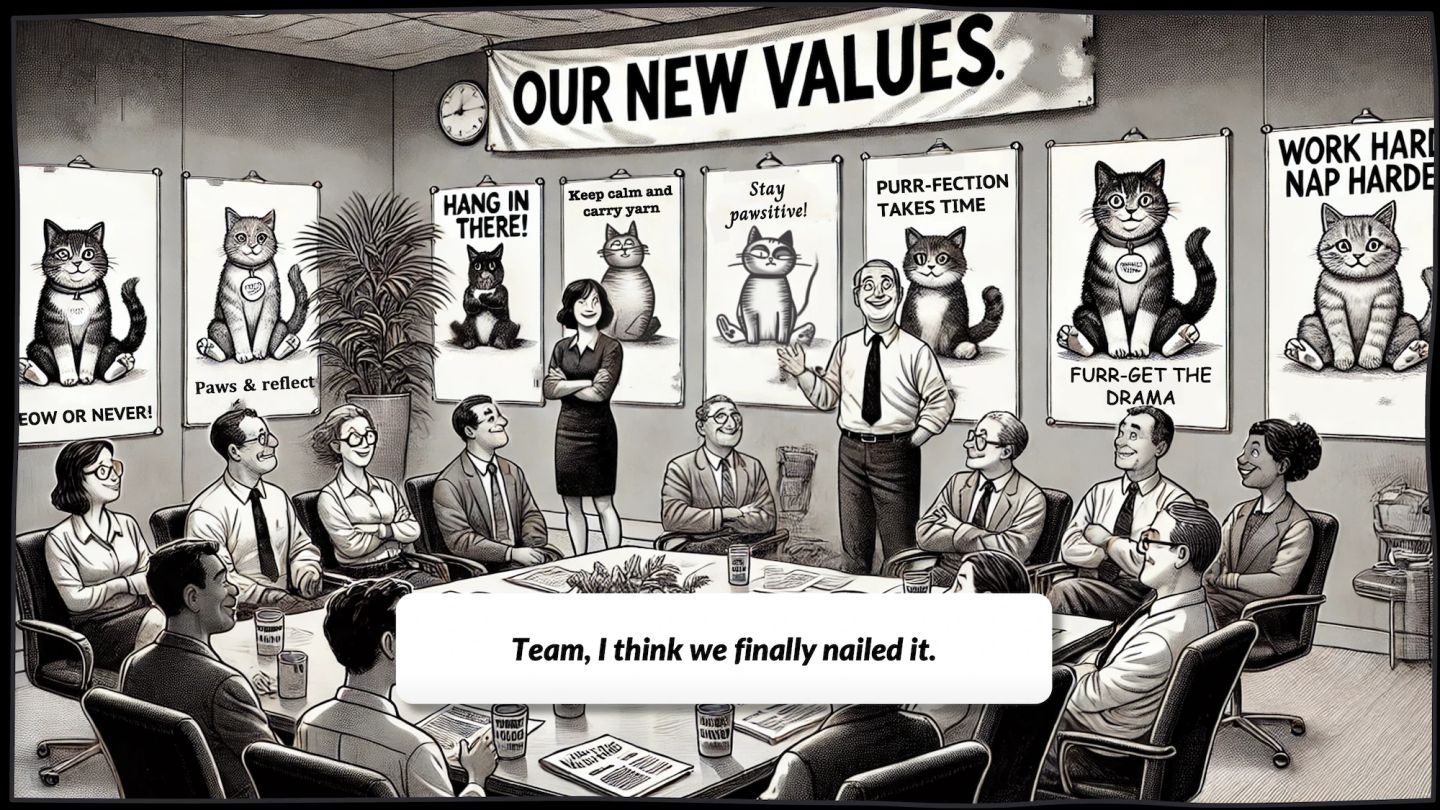
Imagine you work in a typical company. It's the post-pandemic era of back-to-office work policies, layoffs, and AI-driven career uncertainty. Then your company announces it is refreshing its values statement.
In many companies, this announcement would be met with the collective eye-roll of a workforce who feels their leaders are out of touch. So, what is a company to do to create unity, improve decentralized leadership, and signal virtue?
Today, there is a much better option than the traditional values statement of the 1980s.
Yet another 1980s business fad
While there are many amazing gifts that the 1980s bestowed upon humanity - the Macintosh, DNA testing, and the Slinky, to name a few - fad-based management was not one of them. One of those fads was writing values statements.

But as you can see above, many CHROs and CEOs are now souring on the concept. Let's unpack why and what instead.
Oh, the hypocrisy!
In 2016, it came to light that Wells Fargo had created a high-pressure culture that led to employees opening millions of accounts that customers never asked for. At the time, Wells Fargo's values statement was:
- People as a competitive advantage
- Ethics
- What's right for customers
- Diversity and inclusion
- Leadership
The shady business practices that reportedly went back more than a decade violated at least four of their values on a widespread scale.
With a generation of people at work seeing scandals and employee-unfriendly behavior by companies, trust in companies has eroded. Values statements feel more like lip service than reality.
Given that, what should a company do?
Principles versus habits
Growing up, my parents had a sacrosanct rule. Fifty years later, it is the only rule I even remember: we weren't allowed to disrespect books. For example, it was treated as a sin to leave a book on the floor or use it as a booster seat. It was forbidden to use a book for anything but its primary purpose—to share knowledge. This is how my parents taught us how much they valued knowledge and education. They never uttered the principle, "we value education," but instead, they showed it through habits that I continue practicing to this day.
As you can see, there are many ways to express a value. For example, take the simple value of "honor your mother and father." This could be expressed in a number of ways:
- Honor your mother and father
- We are a family that respects elders
- Call your parents every day
- We have family dinner together every night
Implicit in these ways of articulating a value are two dimensions:

As an example, Wells Fargo's values statement was focused on principles and leaned toward individual.
However, today's workforce is better led through collective habits than individually-oriented principles for two reasons:
- Why habits? Actions speak louder than words. High cynicism means that actions will have far more impact than words.
- Why collective? Don't blame the player. Blame the game. Highly challenging work context means that people are already feeling blamed. Individually-oriented values will worsen this feeling.
Why habits? Actions speak louder than words.
Of the various values-like statements out there, only a few have had an impact at the industry level. One was the Toyota Way. The Toyota Way articulates Toyota's approach to adaptive performance in an automobile assembly line. It shares their fundamental belief that everyone is responsible for adaptability (problem-solving, experimentation, and innovation). This philosophy transformed the whole field of manufacturing.

For the most part, the Toyota Way is more about habits than principles, which is why it is so powerful. It is extremely specific.
Anyone with young kids knows how much actions matter more than words when instilling behavior, but this has been demonstrated with adult leadership also.
For example, one study wanted to understand what it would take to get employees to speak up more and share their ideas. What they found was a cycle—employees shared ideas, leaders took action, and thus employees felt heard, resulting in more shared ideas. The main determinant of whether employees felt listened to was whether the leader took action based on their input. In 85% of incidents where employees felt heard, leaders acted on their suggestions. Conversely, in 98% of cases where employees felt ignored, no action was taken.
This dynamic is more elicited by today's employee cynicism. Read Blind or Glassdoor reviews and you often run into statements like,
- "Leaders talk about our values but what they do is entirely different."
- "What's the point of saying anything? Nothing will be done."
To beat the cynicism and have more impact, we strongly recommend focusing more on habits than principles.
Why collective? Don't blame the player. Blame the game.
Growing a company today is more difficult than ever before. This increase in difficulty leads to more pressure, and more pressure leads to more blame.
When companies use highly subjective values, those values end up becoming a weaponized tool for blame. Moreover, that blame goes in both directions (leader to employee and employee to leader).
For example, one organization we work with wanted to write a value for "trust," and we recommended not to as the term would become weaponized in both directions. When a leader tries to give bad direction and employees question it, the leader will say, "you don't trust me." Or when a leader is trying to give good direction and an employee feels controlled, they will say, "you don't trust me." But what does trust have to do with it? We've seen this exact scenario play out when companies say they value autonomy or even empowerment.
Habits are more precise than principles. Because they are about discreet actions to take, they are more likely to feel like coaching, and much less likely to be weaponized.
Operationalizing collective habits
To create a values framework that is focused on collective habits:
- Be comprehensive
- Be specific
- Create supportive accountability
1. Be comprehensive
When using habits as a performance lever, it is valuable to be comprehensive. For example, if the only habit we talk about is collaborative problem solving, teams will focus less on the habits of good execution. For most typical organizations, we recommend they start their journey with the 12-habits of high-performing teams:

- These habits have been fine-tuned and iterated over a decade based on the cutting-edge science of performance and motivation.
- These habits balance growth and adaptability with execution.
- These habits cover what the typical team needs to do to maximize growth in today's fast-paced, technologically-oriented, hybrid world of work.
- These habits are generally pretty easy to self-evaluate by the average employee.
By starting with this set and iterating, you're much more likely to get to a good, comprehensive answer.
2. Be specific: permissive versus prohibitive
The second industry-shaping values statement aside from the Toyota Way is the Agile Manifesto. Like the Toyota Way, The Agile Manifesto reads more like habits, but it also leans more toward collective-orientation:
We are uncovering better ways of developing software by doing it and helping others do it. Through this work we have come to value:
- Individuals and interactions over processes and tools
- Working software over comprehensive documentation
- Customer collaboration over contract negotiation
- Responding to change over following a plan
That is, while there is value in the items on the right, we value the items on the left more.
The Agile Manifesto is rare in that it is simultaneously permissive and prohibitive.
In society, there are generally two legal frameworks:
- Permissive - where laws tell you what's allowed, and everything else is illegal. For example, in pharmaceutical regulation, only drugs that go through an extensive process are legal, and by default, everything else is illegal.
- Prohibitive - where laws tell you what's not allowed. This is the typical practice of Common Law.
By using an approach that is both permissive and prohibitive, the Agile Manifesto increases clarity.
As an example of this in practice, for our default set of collectively-oriented habits, we include a similar subtitle for each:
3. Creating supportive accountability
Anything worth doing in an organization needs to have a mechanism of supportive accountability. Behaviors without accountability mechanisms will ultimately atrophy as people focus on the tasks where the accountability mechanisms are strong.
Unlike controlling accountability, which tends to be demotivating, supportive accountability helps people to achieve what they want to achieve.
With principles, it is hard to create supportive accountability.
For example, it would have been extremely hard for a person at Wells Fargo to evoke their value of Ethics in a conversation with a leader who was being unethical. It's too accusatory and confrontational. This is why invoking principle-based values in development conversations often feels like a nuclear option.
On the other hand, with a well-constructed set of habits, supportive accountability is easier to create. After all, most people understand the importance of habits in creating good outcomes, whether they be fitness habits or studying habits. And most people also understand that maintaining these habits is not as easy as it sounds. I, for one, highly welcome my spouse's supportive accountability as I'm trying to defeat my sugar addiction.
To create supportive accountability for these habit-based values, we recommend a quarterly Culture Check process.
In this process, each team gathers for about 90 minutes (which can be done in 1 to 3 different meetings). In those meetings, the team first does a self-diagnostic on the aforementioned 12 habits of high-performing teams.

Artificial intelligence in the Factor.AI platform then gives each team specific hypotheses describing why a specific habit needs to be improved.

The team takes action and decides on changes to make accordingly.
Not only does this signal how much these habits are valued in an organization, but also, it teaches teams that they are not victims of circumstance. Instead, they have the agency to make their work life better.
Culture Checks are at the cutting edge of applied organizational psychology. Try them now with your team.
Get it done
Company performance cultures are eroding fast. Employees are burned out and quiet quitting. Many companies are confused and grasping for straws. The legacy approach often taken to improve performance cultures has been a four-legged stool that included:
- Values statements
- Leadership development
- Culture surveys
- Personality tests
This article is the first in a four-part series that will show that all four of these levers are no longer effective in today's workforce. However, what is accessible combines all four into one intervention.
A good collectively-oriented habit framework for your values statement has the potential to:
- Be a much more impactful values statement
- Replace leadership development with an emphasis on leading the team habits
- Replace culture surveys with Culture Checks
- Replace personality tests with a less troublesome framework connected to the habits
In other words, today's state of the art is more effective, cheaper, and simpler. Better still, it is shockingly simple to implement.
- First, do a Culture Check with your executive team.
- Second, if needed, iterate the default habits to suit your organization.
- Third, communicate the intent of Culture Checks to the organization.
- Fourth, cascade Culture Checks down from the executive team to their directs down to the frontline.
- Fifth, repeat this process every quarter.
- Sixth, conduct quarterly leadership boosters specific to each team's Culture Check.
Lastly, communicate the habits broadly as your core leadership principles.
Follow this simple and practical approach and you will find your organization's motivation and performance increasing quickly.
About the authors
Lindsay McGregor
Meet Lindsay McGregor, the best-selling co-author of Primed to Perform, and co-founder of Factor.ai and Vega Factor. She's on a mission to build organizations that are AI Native & People First, because, let's be honest, who wouldn't want a world where every company thrives and everyone genuinely loves their career?
Lindsay is a hard-working nerd at heart. She holds an MBA from Harvard Business School and an undergraduate degree from Princeton University. A former McKinsey & Company consultant, she's also a New York City Library cardholder and a science fiction enthusiast.
Today, Lindsay isn't just talking about change; she's making the tools and doing the science needed to ensure everybody has great professional lives. It's safe to say, she's making work work better for everyone.
Neel Doshi
Meet Neel Doshi, the best-selling co-author of Primed to Perform, and co-founder of Factor.ai and Vega Factor. He's dedicated his career to a pretty ambitious goal: creating a future where all companies are high-performing because they're AI Native & People First. Think of it as making work so good, people actually look forward to Mondays.
Neel looks at this challenge through the eyes of an engineer. He earned his engineering degree from MIT and his MBA from the Wharton School. A former Partner at McKinsey & Company, he's also a Kentucky Colonel and a graduate of the Bronx High School of Science. Neel takes science-nerd to all new heights.
Currently, Neel is focused on showing the world that through science and AI, every team and company can be extremely motivating and high-performing. No one need be left behind in the march of progress.
Learn more
- Blame is why your culture is low-performing - This article explores how blame can undermine a company's culture and performance. It offers insights into creating a supportive environment that fosters motivation and accountability, aligning well with the idea of focusing on collective habits.
- How company culture shapes employee motivation - Delve into the science behind how culture influences motivation and performance. This piece complements the discussion on moving from values statements to habit-based frameworks by highlighting the importance of intrinsic motivators.
- Stop blaming me and calling it "accountability" - Learn about creating a culture of accountability that supports rather than blames. This aligns with the article's emphasis on supportive accountability through Culture Checks.
- It isn't just you - work really has become more dysfunctional - Understand the root causes of organizational dysfunction and how to address them. This article provides context for why traditional values statements may no longer be effective.
- Building high-performing teams with Culture Checks - Discover how regular Culture Checks can improve team performance and motivation, echoing the article's recommendation for Culture Checks as a tool for supportive accountability.