It isn't just you - work really has become more dysfunctional
Rebuild organizational performance in an era where new norm volatility and change is the current reality
Organizational dysfunction is a systemic reaction to unprecedented volatility and rigid management models that prioritize compliance over adaptability. VEGA loops solve this by replacing outdated memos and meetings with high-frequency feedback. This AI-Native & People-First approach uses triannual strategy, culture, and skill checks to navigate layer transitions and ensure talent remains motivated to solve growth-oriented problems.


It is really hard to be a middle manager or team leader today. Organizations are becoming more dysfunctional, and for the most part middle managers are being blamed for it.
Surveys suggest that between 50% and 75% of workers deem their company to be dysfunctional. And, amazingly, companies are typically doing very little about it.
The problem is that most leaders don't understand where this dysfunction comes from. Without this understanding, companies often waste their time on shallow interventions, lip service, or "blame the victim" interventions.
Let's unpack the root causes of organizational dysfunction. How is it that groups of very smart people can ever perform poorly?
The roots of dysfunction
The Vega team is closely partnered with a technology company - let's call them "Acmetech" - on reshaping their operating model. A few years ago, as dysfunction started to creep in, Acmetech decided that the solution was more memos and more meetings. Rather than being either a writing culture or a meeting culture, they opted for both.
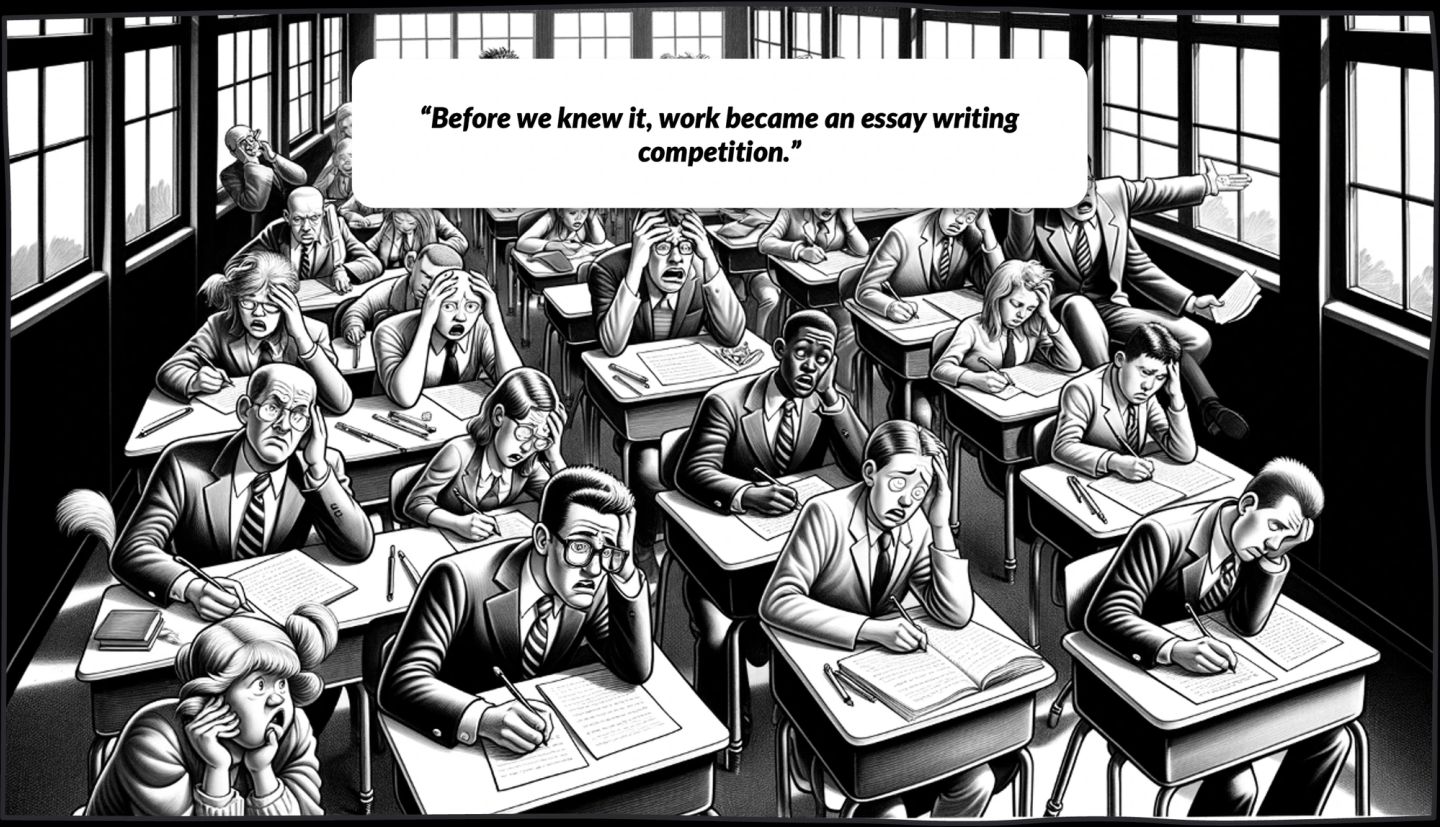
Of course, this didn't solve their dysfunction, but rather worsened it. Every decision started to take longer, so they became slower and slower. Leaders started spending all of their time in meetings, or even meetings to prep other meetings. Given the amount of writing they were doing for high-pressure interactions, leaders felt like they lived in a permanent essay writing competition.
So if more meetings with more memos isn't the solution to dysfunction, then what is?
To create highly functional organizations at scale, leaders must first understand the five most common root causes of organizational dysfunction:
- The world is more volatile
- Companies are not built for volatility
- Scaling without skilling
- Mismatched time horizons
- The nature of work itself is completely changing
① THE WORLD IS MORE VOLATILE
Any high-performing machine must be able to withstand volatility, aka rapid, unpredictable change. For example, imagine you wanted to build a high-performing car. If that car is supposed to be able to navigate snow, rain, wind, and rugged roads, then it has to be built for rapidly changing situations. Imagine driving a race car to work in a blizzard in Minnesota. No matter how good of a driver you are, if the car isn't built for those conditions, you're going to be at risk of crashing.
Today, the world is in a heightened state of volatility on almost every dimension—economic, geopolitical, environmental, technological, and even consumer preferences. Consider the wide-reaching issues of just the last few years:
- Pandemic (we isolated for two years!)
- Remote work (everyone learned video conferencing in one year!)
- Supply chain bullwhip effects (we continue to contend with wide-ranging supply chain problems, including a boat stuck in the Suez Canal for six days)
- Growing conflict and war (including war in Europe and the Middle East)
- Hybrid work (the new norm of post-pandemic work)
- Inflation (the highest in decades)
- Generative artificial intelligence
Any of these changes on its own would be enough to rock the seas of business. To have seven of them in just the last five years is unparalleled.
② COMPANIES ARE NOT BUILT FOR VOLATILITY
In the worldwide bestseller Primed to Perform, we shared a critical concept about organizational performance: there are two types of performance, but most organizations only focus on one.
- Tactical performance is about convergence toward existing goals and processes. Through tactical performance, we get an organization to "fall in line" and create scale.
- Adaptive performance is about divergence from business as usual. Through adaptive performance, we get an organization to solve problems and innovate.
When you combine both types of performance, there are four types of company operating systems:

Take a moment to read through the self-diagnostic below and see which archetype best describes your company.

If you're in any quadrant but the upper-right (number 4), then odds are you won't be able to drive performance through the current state of global volatility.
If you'd like help thinking through how your organization balances tactical and adaptive performance, reach out.
③ SCALING WITHOUT SKILLING
Organizations often come to us when they are experiencing sudden bouts of dysfunction (which makes sense given our research and tools). One of the most common reasons is that they are experiencing what we call a 'layer transition". This is what happens when an organization outgrows its current number of leaders and has to either hire or promote a cohort into a new layer of leadership. This often creates profound growing pains as folks are either managing way more people than they're used to or there are brand new leaders from outside entering an existing culture.
To understand this dynamic mathematically, take a look at the chart below. Assume that on average, each leader manages 8 people. As the number of employees increases from 9 to 17, a new layer of leadership is needed; everyone goes from reporting to the CEO, to 8 people who report to the CEO and 8 people who each report to one of those leaders.
This structure works for a while - until about 137 employees, when another layer of leadership is needed.
This pattern repeats again around one thousand employees, then again around ten thousand employees.

Each of these layer transitions requires an organization to make deep changes to its operating model - how it coaches, solves problems, and forms teams. A new class of leaders has to manage problems that were once owned at a higher level.
As a result, these layer transitions tend to be moments of peak dysfunction, either because organizations don't reconfigure their operating model, or because they focus their operating model on tactical performance at the expense of adaptive performance.
At the most fundamental level, every organization must manage three levers of performance:
- The WHY (why do we exist / what is the problem we're trying to solve?)
- The WHAT (what is our solution to that problem?)
- The HOW (how are we building/providing that solution?)
And - you guessed it - each of these three levers of performance has a tactical and adaptive side:

As organizations scale and layer transitions occur, issues pop up along all five of these levers. To navigate these transitions, leaders must equip themselves with theory, methods, and tools that properly balance both tactical and adaptive performance. Unfortunately (though understandably) most organizations double down on tactical performance, neglecting the adaptive.
| Performance lever | Issues that arise with scale |
|---|---|
Motivation (tactical and adaptive performance) | As organizations scale, context grows exponentially. For new colleagues, it is often too difficult to learn the context necessary to have agency. Without agency, the drivers of motivation (play, purpose, and potential) atrophy. They end up getting replaced with emotional pressure, economic pressure, and inertia. High-performing leaders learn how to create accountability without blame. |
Strategy / Goals (tactical performance) | Organizations become overly fixed on rigid goal systems. High-performing leaders learn how to replace OKRs with inclusive, strategic thinking. |
Problem solving (adaptive performance) | Organizations don't consider how to effectively scale problem solving, resulting in more meetings, more memos, and thus more high-performer burnout. High-performing leaders learn how to end wasteful meeting cultures. |
Process (tactical performance) | When organizations scale, they tend to put all their energy into process management and task completion. However, this is only solving for tactical performance. High-performing leaders learn how to use process for continuous improvement and learning. |
Skill (adaptive performance) | When process isn't enough, skill is required. However, as organizations scale, they do little to invest in skill growth. As a result, there is a worldwide skill gap in critical leadership and problem solving skills. High-performing leaders learn how to ditch "feedback" and instead create an "apprenticeship" culture. |
④ MISMATCHED TIME HORIZONS
A few years ago, Neel was participating in a meeting with the c-suite of a financial institution Vega worked with. The head of sales and head of product were having a deeply heated argument. Leaving this meeting, it felt like their relationship was damaged. But they didn't even disagree on what the problem was or how to solve it. They just disagreed on when to implement certain ideas. Their relationship was another casualty of misaligned time horizons.
The revenue growth engines of companies are often a four-legged stool with Product, Operations, Marketing, and Sales. Each of these legs tends to have a different primary time horizon that they are solving for.
- Sales—very short, often solving immediate problems like how to close a deal TODAY.
- Operations—somewhat short as well, often having to address critical customer needs within DAYS or WEEKS.
- Marketing—somewhat longer, because marketing campaigns, optimizing a marketing funnel, and brand building can take MONTHS or more.
- Product—longer still, especially as organizations have embraced software. Developing a great product can take YEARS of development and iteration.
This difference in time horizon isn't a problem in and of itself. However, fractures occur when colleagues from different departments gather to solve problems that require a wide range of expertises - an increasing need in a world of increasing volatility.
In this financial institution c-suite example, tempers cooled once we led a discussion to clarify time horizons.
To save themselves massive headaches and avoid dysfunction, leaders should actively signpost what time horizon they are solving for in any given discussion, or what time horizon they are advocating for when presenting solutions.
⑤ THE NATURE OF WORK ITSELF IS COMPLETELY CHANGING
Driven by the accelerating wave of automation - more and more in the form of artificial intelligence - more and more human work is increasingly shifting from tactical performance to adaptive performance.
This shift has several radical implications:
- Collaborative problem solving and experimentation are becoming more necessary, and thus more valuable.
- Roles will need to be redefined to allow humans to use AI for nearly all of their tactical performance. If done successfully, this will create a massive step-change in the average person's productivity.
- Org structures will need to be more cross-functional, and strategic planning cadences will need to be faster and more decentralized.
- Problem solving skills will be prized. Increasingly, organizations will seek more skilled talent wherever they happen to live, rather than limiting themselves to the talent pools in their local area.
- Teams will continue to work in hybrid ways (i.e., partly in-person, partly remote).
Meanwhile, all of this aligns with what modern employees want from their workplace. It's no longer controversial that Millennials and Gen Z are less likely than prior generations to place work at the center of their identity. They also expect more agency, flexibility, and collaboration at work. There is little reason to think that this trend will slow or reverse anytime soon.
High-performing leaders will learn how to engage and develop colleagues in inclusive, collaborative problem solving without relying on in-person work or meetings.
What can you do to avoid dysfunction in your org?
The business memo was invented in the 1870s, around when the first commercially sold typewriter was created. In the intervening 150 years, the complexity and volatility of business has increased exponentially, and humanity has developed better digital tools to manage work - and artificial intelligence. So why are we still using memos, a 150-year-old tool? This is just one example of how out-of-date most companies' management systems are.
By now, you hopefully see the nature of the change that's required if your organization is to navigate the coming wave. The good news is that this problem is entirely solvable using the science of performance.
To get you started, here are a few next steps:
- Share this article with your team.
- Measure your organization's motivation and operating system health.
- Learn how you can use technology to build a high-performing org.
And, as always, feel free to reach out with any questions.
About the authors
Lindsay McGregor
Meet Lindsay McGregor, the best-selling co-author of Primed to Perform, and co-founder of Factor.ai and Vega Factor. She's on a mission to build organizations that are AI Native & People First, because, let's be honest, who wouldn't want a world where every company thrives and everyone genuinely loves their career?
Lindsay is a hard-working nerd at heart. She holds an MBA from Harvard Business School and an undergraduate degree from Princeton University. A former McKinsey & Company consultant, she's also a New York City Library cardholder and a science fiction enthusiast.
Today, Lindsay isn't just talking about change; she's making the tools and doing the science needed to ensure everybody has great professional lives. It's safe to say, she's making work work better for everyone.
Neel Doshi
Meet Neel Doshi, the best-selling co-author of Primed to Perform, and co-founder of Factor.ai and Vega Factor. He's dedicated his career to a pretty ambitious goal: creating a future where all companies are high-performing because they're AI Native & People First. Think of it as making work so good, people actually look forward to Mondays.
Neel looks at this challenge through the eyes of an engineer. He earned his engineering degree from MIT and his MBA from the Wharton School. A former Partner at McKinsey & Company, he's also a Kentucky Colonel and a graduate of the Bronx High School of Science. Neel takes science-nerd to all new heights.
Currently, Neel is focused on showing the world that through science and AI, every team and company can be extremely motivating and high-performing. No one need be left behind in the march of progress.