Why do most strategic goals fail?
Bridge the execution gap by evolving Strategic Planning into a weekly rhythm of problem-solving.
Strategy execution fails when organizations treat goals as static annual plans. The VEGA Model bridges this gap by evolving strategy into a weekly rhythm of adaptive problem-solving. This AI-Native & People-First approach ensures that strategic priorities are continuously tested and refined, allowing teams to navigate complexity while remaining focused on high-impact objectives.


What percentage of New Year's resolutions succeed? A few studies suggest just ~10%. Amazingly that's despite the fact that ~50% of people start the year feeling confident that they will succeed.
What about corporate goals? A study by The Economist found that similarly, only ~10% of executives feel like they succeed in achieving their business goals.
Too often, executives overly rely on goals and ignore the levers that make goals successful. It's like setting some logs on the fire, but then stopping before setting them alight or nurturing the flame.
Let's uncover the real reasons why your goals often fail or backfire.
The three issues with goals
Goals should have two purposes: strategic alignment, and motivation. For a variety of reasons, we see too many goals that fail on both.
Issue 1: Targets without strategy
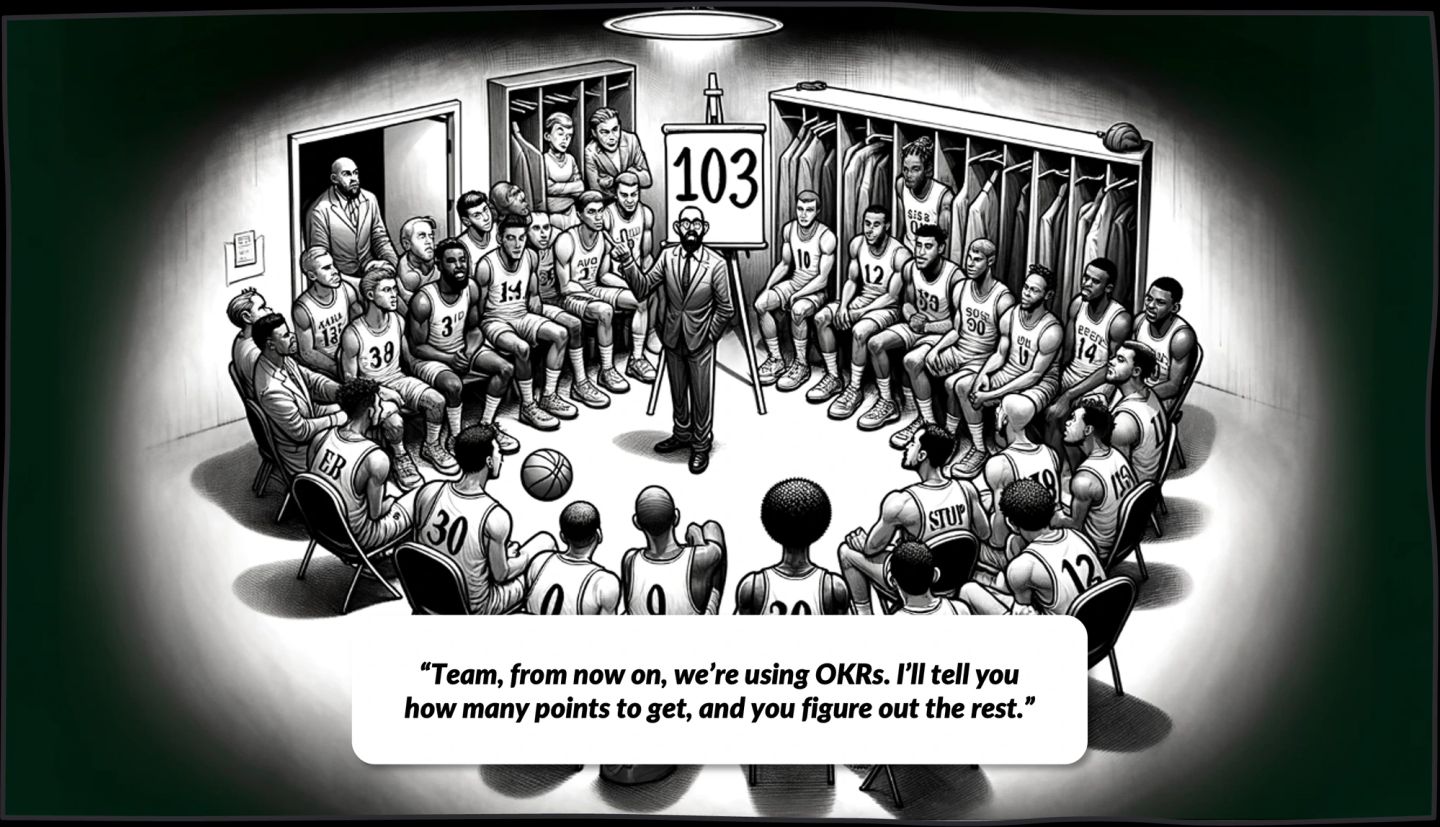
Imagine if a coach's only role was to set the team's goal for each game. What would be the point?
As we work with organizations to build high-performing operating models, this scene is surprisingly common among executives. In one major organization we've worked with, executives negotiate with middle managers on financial targets. Then middle managers have to figure it out. The goal ends up being a contorted compromise between the executive's over-ambition and the middle manager's sandbagging. All of this creates unnecessary short-term pressure that prevents the organization from properly managing risk and creating optimal strategies - not to mention an antagonistic relationship between managers and their employees.
Issue 2: Silo forming
We also often observe executives setting separate goals for each function or individual in their organization. That might look like sales, marketing, product, engineering, and operations all have completely different targets.
For example, in one financial institution, the engineering team's primary target was focused on cost reduction. Meanwhile, the product team's primary target was focused on feature adoption. These two goals have inherent tradeoffs. So, as engineers and product folks collaborated, they frequently clashed. Setting goals this way focused teams on creating a local optima, not a global optima. In other words, separate goals for separate departments led to no cohesive, org-wide strategy.
Issue 3: Not motivation
In the 90's the concept of BHAGs (big hairy audacious goals) became popular. When I was a software engineer at Citi, they launched a goal to have 1 billion customers by 2010. That was the extent of what was communicated to us rank-and-file engineers. Our reaction? A collective shrug.
If you think about this goal from the perspective of a front-line colleague, why would this be motivating?
The five steps to managing goals well
We're not suggesting that you abandon your goals. Having a motivating alignment mechanism makes a lot of sense. Instead, follow this simple five-step process:
- Understand the basic constraints.
- Start with strategy.
- Make prioritization the first part of your weekly rhythm.
- Make problem solving the second part of your weekly rhythm.
- Deep dive or delegate.
① Understand the basic constraints
To get your team's head in the game, share the table-stakes, must-have metrics to keep the organization running. For example:
- Expected costs in the next year
- Core revenue (i.e., the revenue that you will likely earn by doing nothing differently. This excludes one-off and non-recurring revenue, but does include a conservative growth rate based on momentum, if applicable.)
- Critical expectations to meet (e.g., for fundraising)
Teams need to know how much of their performance should come from simply carrying their momentum forward.
② Start with strategy
When companies set goals first and develop strategy second, they end up with overly siloed, short-term, and risk-averse strategies. In this era of rapid technological innovation, this path will be fatal for many companies.
Instead, companies should always have a three-year vision and strategy. This vision and strategy should articulate the next set of customer problems that the organization intends to solve, and how. The goals (i.e., the targets) should be implications of how this strategy plays out.
Let's bring this to life with a hypothetical. Imagine your organization had to prioritize among a set of ideas. Each row in the table below is an idea, and there's one column for Revenue and one column for Efficiency. When an idea has a "+," it indicates that it makes the metric better, and "-" indicates that it makes that metric worse.

Here's the first scenario—the company organizes around metric first:
- You're in charge of revenue and you can pick only one idea. Which do you choose? Idea 1 of course!
- Now a colleague is in charge of efficiency. They also can pick only one idea. Which do they choose? Idea 2 of course!
- The result of this is only +1 in revenue and +1 in efficiency.
Here's the second scenario—the company organizes around strategy first:
- Your executive team realizes the whole company only has the bandwidth for two ideas. Which do you you choose? Ideas 3 and 4!
- The result of this is +2 in revenue and +2 in efficiency.
This is a simplified example, but it models companies we work with every day, whose operating models play out like the first scenario. This is the local vs global optima problem. By starting with strategy, you can achieve global optima. This requires a widely accessible digital space where the team collaborates on problems and ideas. For more concrete advice on how to do this well, check out this article.
③ Make strategy the first part of every team's weekly rhythm
Goals are meant to drive change. Think about it this way: why would an organization go through the effort of setting goals if momentum alone would achieve the target? They wouldn't. Goals most often are used to change trajectory, not maintain trajectory.
Meanwhile, every team has their existing day job, servicing their existing customers on their existing needs. When you look at the average team, they can easily spend 100% of their bandwidth on this reactive kind of work, not the proactive kind of work that goals require.
Even more concerning, with unskilled team leaders, reactive work will often be more motivating than proactive work. Reactive work feels great. It makes you busy. You're adding value. You're helping a customer. Reactive work can often create a deep sense of personal purpose. Without leaders making the proactive work of goals more motivating, teams will naturally gravitate toward the tried-and-true, feel-good, reactive work.
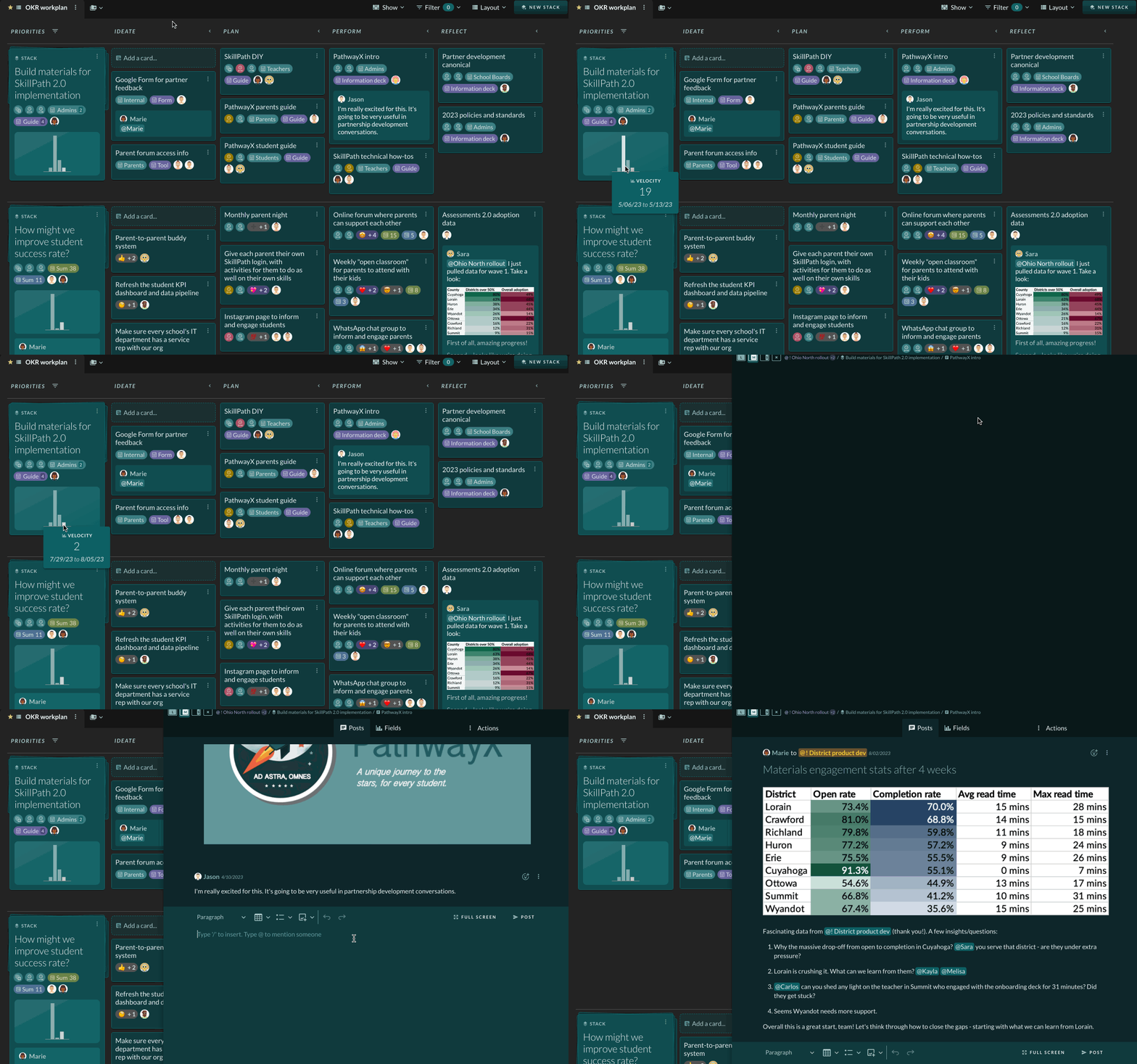
To operationalize goals well, every team needs a strategy that it keeps up-to-date every week to guide its weekly priorities. We strongly recommend that all teams have a weekly prioritization discussion where they actively discuss how much bandwidth they should devote to proactive, growth-oriented work. All of this should be enshrined on a team's strategy board, which is its single source of truth on its priorities.

You can learn more about how to set up strategy boards here, and start trying it yourself.
④ Make problem solving the second part of your weekly rhythm
A major consumer packaged goods company approached us to help them repair their operating model. For almost ten straight years, they would set an annual goal for each of their brands, and almost every year they would miss it. Their goal-setting approach suffered from all the issues we've discussed so far.
First, the finance team would tell the brands what their targets would be. The brands would make detailed plans, which would get approved by many layers of management. Then they would spend the year executing.
In the early moments of this engagement, I asked one of the brand managers, "how soon into the year would you know if your plan is going to fail, so you can adjust?"
He said, "we wouldn't know until the end of the year."
This "task management" approach to achieving goals is dangerous. It puts the organization into the mindset that success is task completion, not impact. Moreover, the assumption that a complex goal can be broken into a year-long plan is hard to accept. Plans typically don't survive contact with reality for more than a few weeks, let alone an entire year.
Instead of making a one-off plan and executing, organizations should continuously problem-solve.
In practical terms, this means that in addition to every team having a weekly prioritization routine, every team should also have a weekly problem solving routine. That routine should surface and contextualize the next problem that must be solved to help the team achieve its goals. Those problems should themselves be prioritized on the team's strategy board.

For example, imagine a retail store for a health insurance company. To drive customer growth, the next problem the team may need to solve is growing walk-in traffic to the store. Maybe the next problem after that is dealing with poor service in peak hours.
Problem-solving doesn't just increase the odds of success; it makes the work more interesting and motivating.
Consider the banking BHAG example shared above:
- This was the boring and meaningless BHAG goal from Citi in the 90s: "Our goal is to get 1 billion customers by 2010."
- Now here's a more problem solving-oriented approach: "The internet is a powerful new tool to solve a problem that has never before been solved in banking: how can we create the kind of non-linear growth effects that would allow us to impact billions of people, not millions of people? Over the next three years, we're all going to figure this out. Send me your ideas here."
If our CEO had communicated the latter, then all of a sudden, instead of a shrug, the typical high-performer would have said "game on".
⑤ Deep dive or delegate
Most executives we see have "delegation" operating models. In these operating models, executives may get a quarterly opportunity to coach their teams. These quarterly business reviews are too rushed for high-quality coaching. This can be disastrous if the problem solving required to achieve a goal is beyond the skill and context of your middle management.
Instead, we recommend that most executive teams run operating models with two gears: delegate or deep dive.
Delegate operating models work more or less like the standard system of quarterly business reviews. However, we recommend that executives use the time to review their direct's full strategy board, including what the team is actively NOT prioritizing. The goal should be for the executive to primarily share advice on "type 2 error" - or in other words, what's missing from the team's thinking?
Deep dive operating models are where the problems to be solved are too complex to expect that working teams alone can get the job done. In these operating models, executives should actively join the team's weekly problem solving routines AND asynchronously engage in the problem solving via the team's strategy board.
Where do you go from here?

In too many organizations, goals are a pressure tactic, not a strategy and motivational tactic. This is an unforced error. Follow the five steps above, and you will significantly increase the odds of growing your impact.
As always, drop us a line if you have any questions or ideas, or if you need some help.
About the authors
Lindsay McGregor
Meet Lindsay McGregor, the best-selling co-author of Primed to Perform, and co-founder of Factor.ai and Vega Factor. She's on a mission to build organizations that are AI Native & People First, because, let's be honest, who wouldn't want a world where every company thrives and everyone genuinely loves their career?
Lindsay is a hard-working nerd at heart. She holds an MBA from Harvard Business School and an undergraduate degree from Princeton University. A former McKinsey & Company consultant, she's also a New York City Library cardholder and a science fiction enthusiast.
Today, Lindsay isn't just talking about change; she's making the tools and doing the science needed to ensure everybody has great professional lives. It's safe to say, she's making work work better for everyone.
Neel Doshi
Meet Neel Doshi, the best-selling co-author of Primed to Perform, and co-founder of Factor.ai and Vega Factor. He's dedicated his career to a pretty ambitious goal: creating a future where all companies are high-performing because they're AI Native & People First. Think of it as making work so good, people actually look forward to Mondays.
Neel looks at this challenge through the eyes of an engineer. He earned his engineering degree from MIT and his MBA from the Wharton School. A former Partner at McKinsey & Company, he's also a Kentucky Colonel and a graduate of the Bronx High School of Science. Neel takes science-nerd to all new heights.
Currently, Neel is focused on showing the world that through science and AI, every team and company can be extremely motivating and high-performing. No one need be left behind in the march of progress.