How can I drive results without burning out my people?
Optimize your Burnout prevention strategy while maintaining high-intensity performance cadences.
High results and low burnout are only possible when motivation is driven by play, purpose, and potential rather than pressure. Total Motivation identifies the six drivers of human performance and provides a framework for managing them. This AI-Native & People-First approach uses automated cadences to lift output while protecting employee engagement.


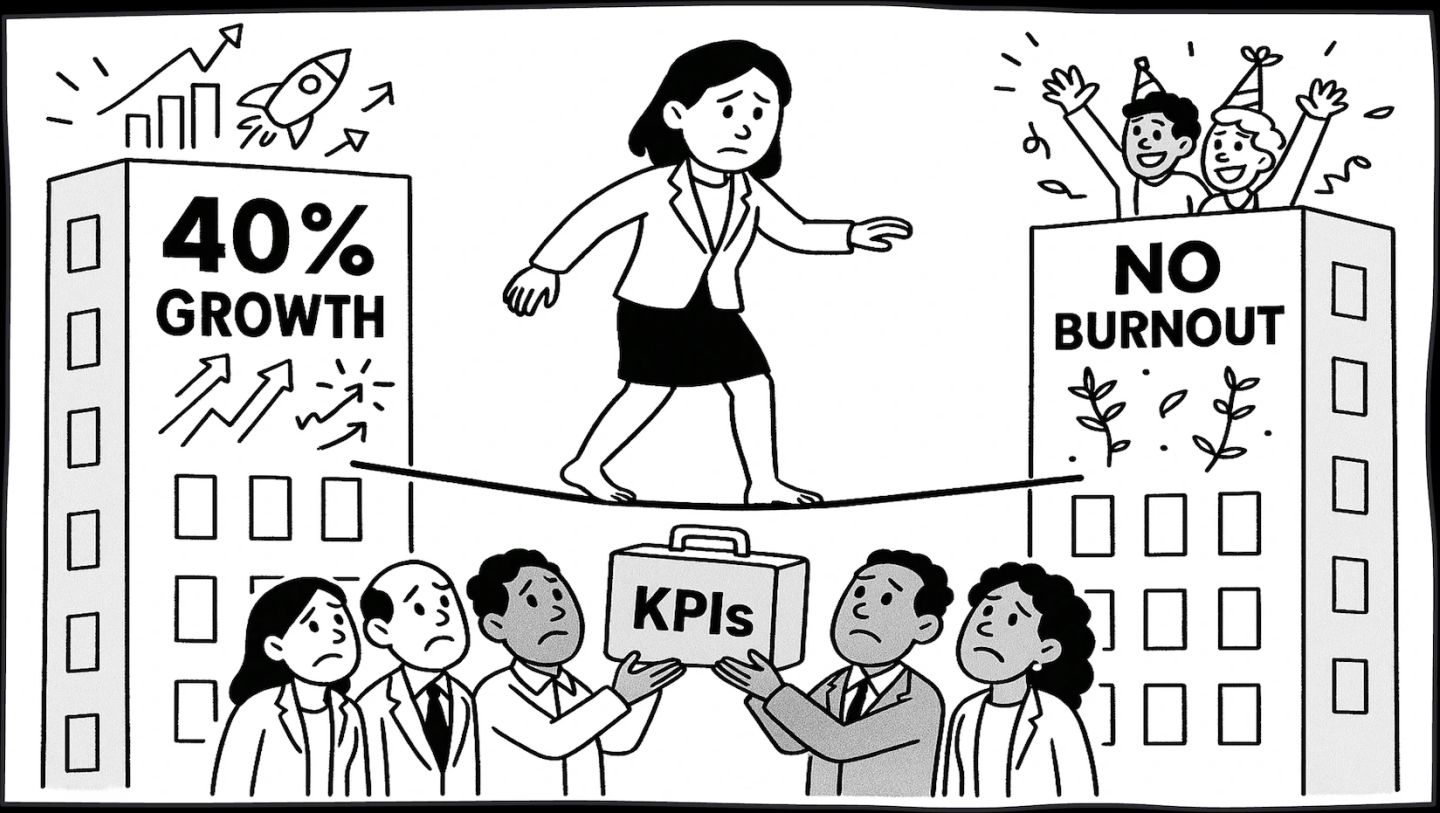
Your board just asked for a 40 % productivity jump—and a Glassdoor rating that stays north of 4.0.
You know the usual playbook: crank KPIs, add dashboards, hold another “accountability” meeting. You also know where that ends—burnout, attrition, stalled growth.
The best leaders do it differently. They treat culture like code and use AI to compile it—turning purpose, clarity and coaching into AI-assisted cadences that run every week, quarter, and year. The result: performance keeps climbing, without leaders pouring on pressure or parachuting into every project.
This article distills what we’ve seen while advising and studying thousands of teams:
- The six motivation drivers that predict whether AI lifts output—or crushes engagement;
- Real-world cadences that replace bloated meetings with breezy, AI-assisted “checks” driven by live insights;
- A 15-minute coaching ritual that frees managers 2+ hours per week while boosting motivation and bottom line results.
If you’re wrestling with the scale-vs-culture bind, consider this your blueprint for adding AI without sacrificing humanity—or your weekends.
How can I drive results without burning out my people?
When we first wrote about company culture nearly a decade ago, culture was often dismissed as intangible, elusive—a "soft" aspect of business left largely to instinct. Today, we know better. "Culture" isn’t magic; it’s mechanics. And it can, and must, be engineered.
Across thousands of leaders we've advised since then, a core lesson keeps proving true: why people work determines how well they work.
Through extensive research involving tens of thousands of professionals worldwide, we distilled human motivation into six core drivers:
- Play: The joy and curiosity inherent in the work itself.
- Purpose: Feeling like you're making a meaningful difference by showing up.
- Potential: Opportunities for personal growth and achievement.
- Emotional Pressure: Working under threat to personal identity or from peer pressure.
- Economic Pressure: External incentives or punishments unrelated to personal values or enjoyment.
- Inertia: Working out of habit or without clear reasons.

The first three—play, purpose, potential—are direct motives that enhance performance, creativity, and innovation. The last three—emotional pressure, economic pressure, and inertia—are indirect motives, distractions from quality and genuine engagement, ultimately harming productivity.

High-performing cultures consistently maximize direct motives while actively reducing indirect ones. We call this balance Total Motivation (ToMo).

Can motivation be systematized?
Company culture directly influences customer outcomes, innovation, and financial performance. For instance, in sectors from retail to finance, high-tomo teams consistently outperform low-tomo counterparts. For one major retail chain, high-tomo sales associates generated 30% higher revenue. Similarly, hedge fund managers with strong intrinsic motivation achieved notably higher investment returns.
In one randomized-controlled trial we supported at a Fortune 100 bank, high-tomo teams significantly outperformed controls across all three target metrics: productivity, Net Promoter Score, and cross-sales revenue.

Moreover, industries where companies share nearly identical resources—such as airlines or groceries—reveal sharp performance differences linked directly to cultural strength and employee motivation.


The five AI-powered rhythms that boost motivation and performance
Today's most innovative leaders have embraced a management system that systematically cultivates and maintains high tomo. They focus their efforts on strategy, skill, habit, process, and motivation, automating away bureaucratic waste and freeing up time for meaningful leadership.
These leaders utilize powerful AI-enhanced cadences:
- Strategy Checks: Replacing outdated quarterly planning with streamlined, collaborative, 2-hour alignment sessions. This ensures strategic clarity, sharpens purpose, and keeps everyone aligned and agile.
- Culture Checks: Supplanting centralized, blame-and-shame surveys with engaging, 90-minute team sessions. These AI-guided discussions assess motivation, diagnose root causes of burnout and disengagement, and generate concrete, actionable plans aligned with a proprietary framework—the eight habits of high-performing teams (see section 6 here).
- Skill Checks: Transforming dreaded annual 360-degree performance reviews into inspiring, personalized 1:1 conversations powered by real-time AI insights, significantly boosting team potential and engagement.
Weekly rhythms also benefit greatly from these innovations:
- Friday Reflections: An automated, weekly, solo routine that replaces tedious update meetings. Guided 1-on-1 by Factor.AI, each team member succinctly shares accomplishments, insights, key decisions, blockers, shout-outs, and a preliminary plan for the coming week—building clarity, community, and direct motivation.
- Monday Coaching Guides: Personalized priority and problem solving recommendations that eliminate wasteful prioritization stand-ups. These guides provide every individual—not just managers—with clear, concise priorities informed by real-time insights from all the other checks and reflections.
How can you start using AI in your leadership rhythms?
Leaders who adopt AI into their management system aren't just adopting new tools—they’re pioneering a leadership revolution. With AI-driven automation of critical but traditionally cumbersome processes, Factor.AI users gain unparalleled efficiency and profound insights into organizational health. Executives benefit from real-time analytics dashboards, providing instant, comprehensive visibility into velocity, performance, and motivation.
In an era dominated by AI, why not leverage its capabilities where it matters most—in leadership and culture?
If you want to give it a try, reach out for a free coaching session and Factor demo.
And if you'd like to learn more, watch our talk on How to lead high-performing teams in the age of AI:
The leadership imperative for 2025 and beyond
Today’s rapidly evolving business environment—powered by AI, remote work, and relentless innovation—makes culture not merely desirable but essential. Culture engineering, aided by AI, ensures sustained competitive advantage.
Companies that adopt Factor.AI don't just manage culture—they master it. These are the organizations primed to lead and thrive in the age of AI.
Curious? Check out Factor.AI in action.
About the authors
Lindsay McGregor
Meet Lindsay McGregor, the best-selling co-author of Primed to Perform, and co-founder of Factor.ai and Vega Factor. She's on a mission to build organizations that are AI Native & People First, because, let's be honest, who wouldn't want a world where every company thrives and everyone genuinely loves their career?
Lindsay is a hard-working nerd at heart. She holds an MBA from Harvard Business School and an undergraduate degree from Princeton University. A former McKinsey & Company consultant, she's also a New York City Library cardholder and a science fiction enthusiast.
Today, Lindsay isn't just talking about change; she's making the tools and doing the science needed to ensure everybody has great professional lives. It's safe to say, she's making work work better for everyone.
Neel Doshi
Meet Neel Doshi, the best-selling co-author of Primed to Perform, and co-founder of Factor.ai and Vega Factor. He's dedicated his career to a pretty ambitious goal: creating a future where all companies are high-performing because they're AI Native & People First. Think of it as making work so good, people actually look forward to Mondays.
Neel looks at this challenge through the eyes of an engineer. He earned his engineering degree from MIT and his MBA from the Wharton School. A former Partner at McKinsey & Company, he's also a Kentucky Colonel and a graduate of the Bronx High School of Science. Neel takes science-nerd to all new heights.
Currently, Neel is focused on showing the world that through science and AI, every team and company can be extremely motivating and high-performing. No one need be left behind in the march of progress.