Why should your employees follow you? I wish Boeing asked this question.
Move beyond pressure-based tactics to build Leadership Development routines that inspire genuine ownership.
Leadership crises emerge when pressure-based tactics erode safety and ownership. Total Motivation provides a more sustainable path by focusing on the direct motives of play and purpose. By applying the VEGA loops, this AI-Native & People-First approach builds leadership capability centered on coaching and apprenticeship rather than command and control.


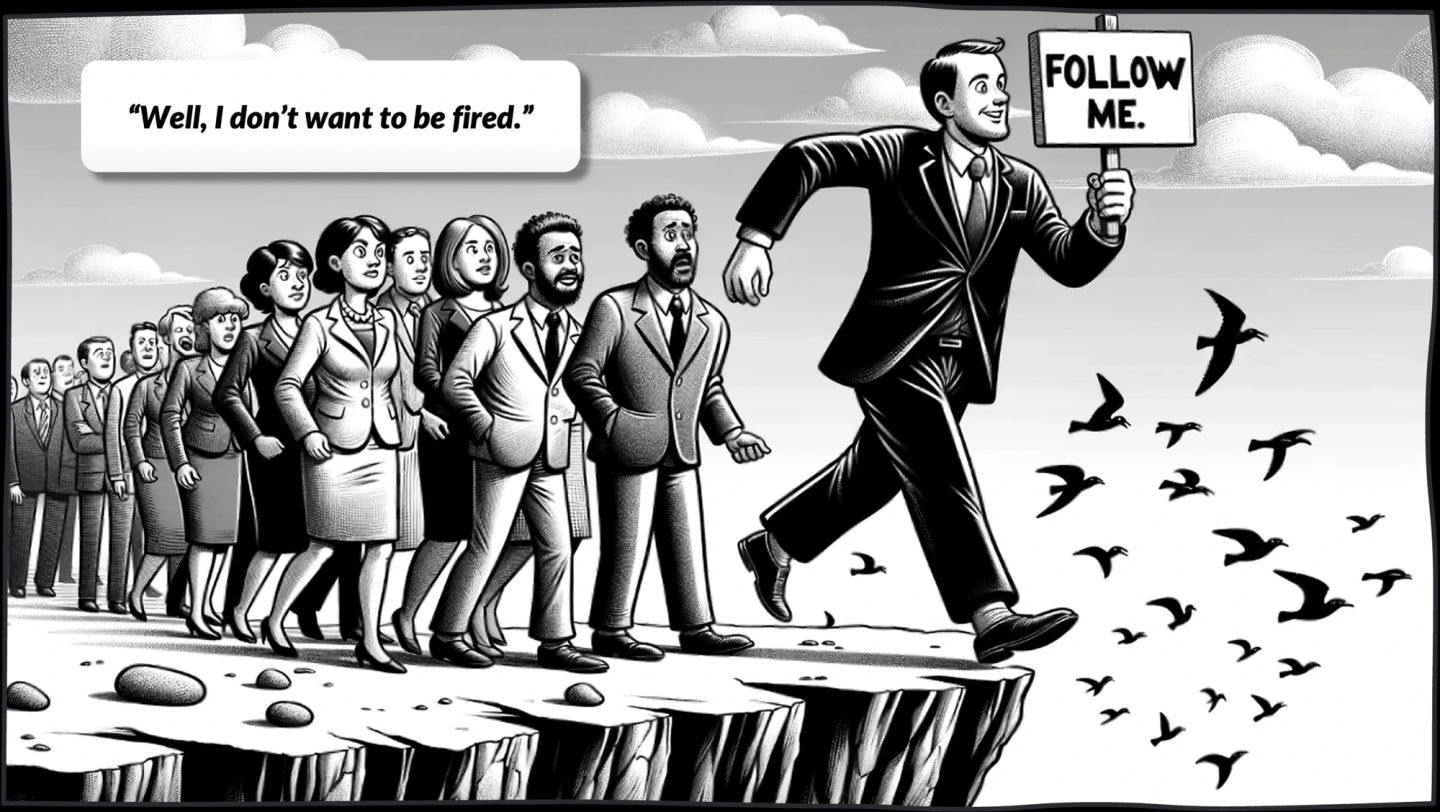
When I was a first-time people leader, I never asked myself the most important leadership question: "why should my team follow me?" And because of that, the answer would have been, "there's no good reason."
After studying the science of performance for the last twenty years, we've concluded that:
- Every leader needs to constantly ask themselves, "why should my team follow me?" And better still, measure the answer.
- Not asking this question creates extraordinary risk, as it did with Boeing and many other companies.
- It's easier than ever to build an organization that gets this right. There's no excuse anymore for not having great leadership.
Let's unpack all of this with a case study that will help you reflect on your own organization.
If it's not Boeing, I'm not going
For the last few years, Boeing has been plagued with quality issues. 346 people died in two crashes of Boeing 737 Max planes in 2018 and 2019. And more recently, Boeing planes have again been in the spotlight for quality-related emergencies.
It hasn't always been this way. Boeing was once a truly legendary organization—the pride of a nation.
Boeing was formed in 1916, almost exactly 100 years before the 737 Max’s maiden flight. William Boeing, a lumber entrepreneur, was tired of waiting for parts for his damaged plane. As a result, in an epic fit of scope creep, he decided he would just build his own aircraft.
To get his fledgling company off the ground, Boeing hired their first engineer, Wong Tsu. Wong, born in Beijing, had graduated from MIT in 1916, with a degree in Aeronautical Engineering. Thus began Boeing’s long history of attracting the best and brightest.
Boeing really took flight only a year later when the U.S. entered World War I and purchased 50 Boeing planes.
From there, for the next 60 years, Boeing led a string of incredible innovations that ushered in a new era of modern travel. For example, Boeing built:
- The first commercially viable jet engine, with the 707.
- The 727, to support flights to developing countries with shorter runways.

There was so much faith in the company that pilots would say, "If it’s not Boeing, I’m not going."
Unfortunately, Boeing's performance culture took a wrong turn.
Why should my team follow me?
At the root of motivation is a person's motive. The word "motive" means the reason for doing something. Every action you take starts with your motives.
We've covered this topic deeply in the worldwide bestseller Primed to Perform, so for now, we'll provide just a fast recap.
A person's motive for any action can come from only a few ingredients:
- The activity or work itself.
- The person's values and identity.
- And lastly, everything else. These are the external forces that are separate from the work and separate from the person's identity.
When you combine these three ingredients, you can derive all the human motives:

- Play: Engaging in work or an activity because it's enjoyable and fun. In other words, it's not boring.
- Purpose: Working because you believe in the value of what you're doing. In other words, you don't feel like a fungible cog in the machine.
- Potential: Seeing the work as a stepping stone to personal growth and long-term goals.
- Emotional Pressure: Being driven by fear, peer pressure, or a desire to please. In other words, you are being manipulated, whether or not you know it, and whether or not it was intentional.
- Economic Pressure: Working primarily to gain rewards or avoid punishments. In other words, you're a puppet on strings.
- Inertia: Working mindlessly, without any real reason.
The first three motives—play, purpose, and potential—are where sustainable adaptive performance comes from.
The second three motives—emotional pressure, economic pressure, and inertia—can create obedience, but they certainly do not tap into the best a person can do.
When you ask the question, "Why should my team follow me?" you're seeking to understand their motive. Think of your team. How would they answer that question?
- Play: My leader helps make the work interesting and fun. There's always a new problem to solve.
- Purpose: My leader always makes sure that I matter as an individual. I never feel like a number or cog in the machine.
- Potential: My leader helps me grow in skills that are leading to my longer-term goals in my career.
- Emotional pressure: I never feel judged or blamed by my leader.
- Economic pressure: My leader never tries to manipulate me with sticks or carrots, and instead helps make me feel secure in my livelihood.
- Inertia: My leader makes sure I never feel disconnected from the right reasons for this work.
Leaders who drive their team with play, purpose, and potential create the highest levels of performance.
Whereas leaders who drive their teams with emotional pressure, economic pressure, and inertia get compliance, cutting corners, and bad risk-taking. This, unfortunately, is what happened at Boeing.
If it's Boeing, I’m not going
In Boeing's golden age, according to author Clive Irving and reported by Quartz:
"Many of the engineers happened to be the guys who pioneered the 707, and… there was a kind of esprit de corps … an integrity of purpose among them… And they had a collective sense of what the company was meant to do and what its responsibilities were."
But then in the late 80s and early 90s, airline deregulation put pressure on margins. Meanwhile, Airbus became a meaningful competitor, winning 15% market share.
In the mid-90s, as the industry went through a momentary slump, Boeing seized the opportunity to acquire their longtime competitor McDonnell Douglas. With the changing of the guard, McDonnell Douglas managers trained in the General Electric high-pressure, stack-rank model of leadership changed the motives at Boeing.
In 1998, the new COO goes on record with a thinly veiled threat disguised as a call for teamwork: "Quit behaving like a family and become more like a team. If you don’t perform, you don’t stay on the team."
Of course, this doesn't help:
- By 1999, Airbus wins the lucrative JetBlue contract.
- In 2003, Airbus surpasses Boeing in plane shipments for the first time in history.
Meanwhile, the Boeing CEO brags about changing the culture. He says, "When people say I changed the culture of Boeing, that was the intent, so it’s run like a business rather than a great engineering firm." His statement implies that you can’t do both, which is clearly not true.
Now with Boeing and Airbus neck and neck, a high-pressure system becomes even higher-pressure. In 2011, American Airlines puts Boeing on notice, asserting that it will shift its orders to Airbus if Boeing doesn’t produce a more fuel-efficient plane quickly. This was the genesis of the 737 Max.
To achieve the goal to build a more fuel-efficient plane in short order, Boeing had to change their planes' engines. The new engines were much larger, and if mounted to the wings in the same place, would be too close to the ground. To compensate, they had to move the engines forward on the wings.
This design change also affected how the plane flew. To avoid all the recertifications and training required by a change in the plane’s handling, Boeing rushed a hack—an automated system called MCAS that would adjust the plane’s angle downward if it sensed a stall. It was this MCAS system that was ultimately responsible for the two 737 MAX crashes.
To ensure that the company delivered this new plane as fast as possible, Boeing doubled down on a culture driven by emotional and economic pressure.
By 2014, the Boeing CEO jokes about their fear-based culture with journalists, saying, “the employees will still be cowering.”
Reporting done by Bloomberg BusinessWeek found that "superiors warned in 'very directly and threatening ways' that pay was at risk if the targets weren’t met." Reporting by The New York Times found, "This program was a much more intense pressure cooker than I’ve ever been in."
When motives shift from play, purpose, and potential to emotional pressure, economic pressure, and inertia, organizations predictably see worse problem-solving behaviors driven by:
- The distraction effect (or rushing the work): A Boeing employee said, "It was pretty intense low morale … So you really watched your step and were careful about what you said."
- The cancellation effect (or blind compliance): "Would you put your family on a MAX simulator trained aircraft? I wouldn’t."
- The cobra effect (or gaming the system): "I still haven’t been forgiven by God for the covering up I did last year. Can’t do it one more time. Pearly gates will be closed."

A high-pressure environment at Boeing ultimately led to hasty, high-risk decisions and poor quality from otherwise brilliant people.
Because performance cultures are built by ecosystems, not values statements, they are difficult to change.
That's why Boeing continues to be plagued by quality issues that have tarnished a hundred years of hard earned reputation.
- As the CEO of Ryan Air recently shared, "In 2022 and 2023, we were finding little things like spanners under the floorboards, in some cases, seat handles missing, things like that. ... This shows a lack of attention to detail, quality issues in Boeing."
- Kayak is now allowing users to filter flights that use Boeing planes.
- The Boeing CEO has resigned over this.
- Boeing allowed their biggest competitor to catch up and surpass them. The very strategy meant to make them higher performing made them lower performing.

We wish this pattern was uncommon.
- This pattern led to the undoing of Enron. Jeff Skilling, the convicted former president of Enron, believed that "money and fear were the only things that motivated people."
- This pattern led to the scandal at Wells Fargo. The use of excessive pressure at Wells Fargo led to them creating millions of fake accounts. The pressure was so great that it led to "frequent crying, levels of stress that led to vomiting, and severe panic attacks."
- This pattern led to the emissions scandal at Volkswagen.
- Even insiders at Google are describing a similar phenomenon. Here's a Google executive describing how the use of emotional and economic pressure is replacing play and purpose:
"The mice are regularly fed their 'cheese' (promotions, bonuses, fancy food, fancier perks) and despite many wanting to experience personal satisfaction and impact from their work, the system trains them to quell these inappropriate desires and learn what it actually means to be 'Googley' — just don’t rock the boat. As Deepak Malhotra put it in his excellent business fable, at some point the problem is no longer that the mouse is in a maze. The problem is that 'the maze is in the mouse'."
The irony of all this is that there are much better ways to drive performance.
How can you build a culture based on the right motives?
Our work at Vega and Factor solves these problems. We aim to build the highest performing organizations possible. This means that the organization is continually asking (and improving the answer to) the question, "why should my employees follow me."
The most common issue we see is that as organizations scale, they tend to replace great leadership with high-pressure processes. While it often remains unsaid, one of the reasons why they do this is they feel like they cannot scale great leadership.
Today, it is easier than ever to scale great leadership all the way down to front-line teams. To do so, we strongly recommend organizations create supportive accountability for three quarterly cadences.
- Culture Checks
- Strategy Checks
- Skills Checks
Culture Checks
The first quarterly cadence is called a Culture Check. In a Culture Check, every single team analyzes its own motives and takes steps to improve them by creating a better performance culture. The Culture Check is the most effective method we've found for helping leaders grow the skills of driving performance and motivation. Moreover, they are very easy to do with a simple four-step process:
- Every quarter, the team meets for 90 minutes.
- In the first 10 minutes of the meeting, each team member completes a Culture Check diagnostic survey. Once they are done, the team will instantly get a customized discussion guide.
- Then, for the remaining 80 minutes, the team follows the discussion guide, which helps them:
- Understand what's increasing their motivation
- Understand what's decreasing their motivation
- Plan actionable next steps to improve their motivation and performance culture
- Executives create supportive accountability by:
- Doing this rhythm themselves
- Making sure all teams complete their Culture Checks
- Joining the Culture Checks of particularly struggling teams
- Reviewing the output of their Culture Checks each quarter
- And, occasionally, launching simple workshops if many leaders are struggling with the same issues
Let's face it: if normal interventions (e.g., leadership trainings, culture surveys) were enough, we wouldn't have lousy cultures. Culture Checks are the missing piece of your culture strategy.

Strategy Checks
The second quarterly cadence is called a Strategy Check. In a Strategy Check, every team again should spend 2-4 hours as a team. In that interaction, they make their strategy for the quarter clear. Here's how:
Every quarter, the team meets for 2-4 hours.
- In that meeting, they:
- Craft the problem statements the team is meant to focus on in the quarter
- Prioritize those problem statements (in rank order)
- Clarify the roles of the problem statement using the FORCE model:
- F = followers
- O = owners
- R = reviewers
- C = coaches
- E = experts
- Clarify the immediate next step to build momentum
- Again, executives ensure every team does this and provide coaching on those problems. The coaching should seek to solve three problems:
- Type 1 error - The team is focused on the wrong problems or wrong priority
- Type 2 error - The team is missing a problem
- Type 3 error - The problems need to be factored differently. For example, the team needs to combine forces with other teams to achieve synergy.
By focusing every team on a problem-solving based approach to strategy, their work will be more useful and motivating.

Skill Checks
The third quarterly cadence is called a Skills Check. In a Skills Check, leaders conduct a 90-minute one-on-one with each of their direct reports. The purpose of this is to support career development and plan skill growth. Here's how:
- Every quarter, each colleague meets with their reporting leader for 90 minutes.
- In that meeting they:
- Walk through a structured and templated conversation on their work for the quarter and their career aspirations. This is meant to remind them both of what most motivates that colleague.
- Choose two specific skills to work on.
- Develop a plan to grow that skill through on-the-job practice, also known as apprenticeship.
- Again, executives provide supportive accountability by:
- Doing this rhythm themselves.
- Making sure all leaders complete the rhythm.
- Helping leaders who are struggling.
- Providing resources to close widespread skill gaps.

Don't let your company become a cautionary tale
Amazon is an organization that has scaled in ways that are unprecedented. The company is only three decades old and has, at last count, around 1.5 million employees. It too has seen the challenges that come with scaling leadership.
To help define how leaders at Amazon should behave, they have written their Leadership Principles. For Amazon, these are akin to commandments carved in stone. So in 2021, when Amazon announced a new principle, it was a big deal. The principle says:
Strive to be Earth’s Best Employer
Leaders work every day to create a safer, more productive, higher performing, more diverse, and more just work environment. They lead with empathy, have fun at work, and make it easy for others to have fun. Leaders ask themselves: Are my fellow employees growing? Are they empowered? Are they ready for what’s next? Leaders have a vision for and commitment to their employees’ personal success, whether that be at Amazon or elsewhere.
In this principle, aside from bridge words, only a few words are written more than once.
| Word | Word frequency |
|---|---|
| leaders or lead | 4 |
| work | 3 |
| more | 3 |
| fun | 2 |
In a principle aiming for efficient use of language, the word "fun" appears twice. Amazon is realizing how important proper motivation is at their scale.
Like Amazon, if you want to create an organization that is truly built to last, it is time that you master the question, "Why should your employees follow you?"
To get started, implement Culture Checks, Strategy Checks, and Skill Checks. Depending on the team, we find there are two ways to implement this cadence.
- Option 1 - the team does a quarterly offsite where they conduct all three checks. Even the Skills Checks can be conducted as groups, although this requires a team with a low degree of emotional pressure.
- Option 2 - the team spreads these cadences across the three months of a quarter like this:
| Month | Cadence |
|---|---|
| January, April, July, October | Strategy Check |
| February, May, August, November | Skills Check |
| March, June, September, December | Culture Check |
If you want to apply this to your company and accelerate your journey, please don't hesitate to reach out to us. We're happy to help you build a legendary, high-performing culture.
Lindsay McGregor
Meet Lindsay McGregor, the best-selling co-author of Primed to Perform, and co-founder of Factor.ai and Vega Factor. She's on a mission to build organizations that are AI Native & People First, because, let's be honest, who wouldn't want a world where every company thrives and everyone genuinely loves their career?
Lindsay is a hard-working nerd at heart. She holds an MBA from Harvard Business School and an undergraduate degree from Princeton University. A former McKinsey & Company consultant, she's also a New York City Library cardholder and a science fiction enthusiast.
Today, Lindsay isn't just talking about change; she's making the tools and doing the science needed to ensure everybody has great professional lives. It's safe to say, she's making work work better for everyone.
Neel Doshi
Meet Neel Doshi, the best-selling co-author of Primed to Perform, and co-founder of Factor.ai and Vega Factor. He's dedicated his career to a pretty ambitious goal: creating a future where all companies are high-performing because they're AI Native & People First. Think of it as making work so good, people actually look forward to Mondays.
Neel looks at this challenge through the eyes of an engineer. He earned his engineering degree from MIT and his MBA from the Wharton School. A former Partner at McKinsey & Company, he's also a Kentucky Colonel and a graduate of the Bronx High School of Science. Neel takes science-nerd to all new heights.
Currently, Neel is focused on showing the world that through science and AI, every team and company can be extremely motivating and high-performing. No one need be left behind in the march of progress.