Expensive mindfulness training doesn't work. Do this instead.
Address systemic friction to improve Workplace Belonging and performance more effectively than stand-alone workshops.
Wellbeing interventions often fail because they don't directly address the root causes of workplace stress. Total Motivation demonstrates that addressing cultural friction is more effective than individual workshops. This AI-Native & People-First approach uses VEGA loops to identify and remove the systemic performance blockers that lead to disengagement and burnout.


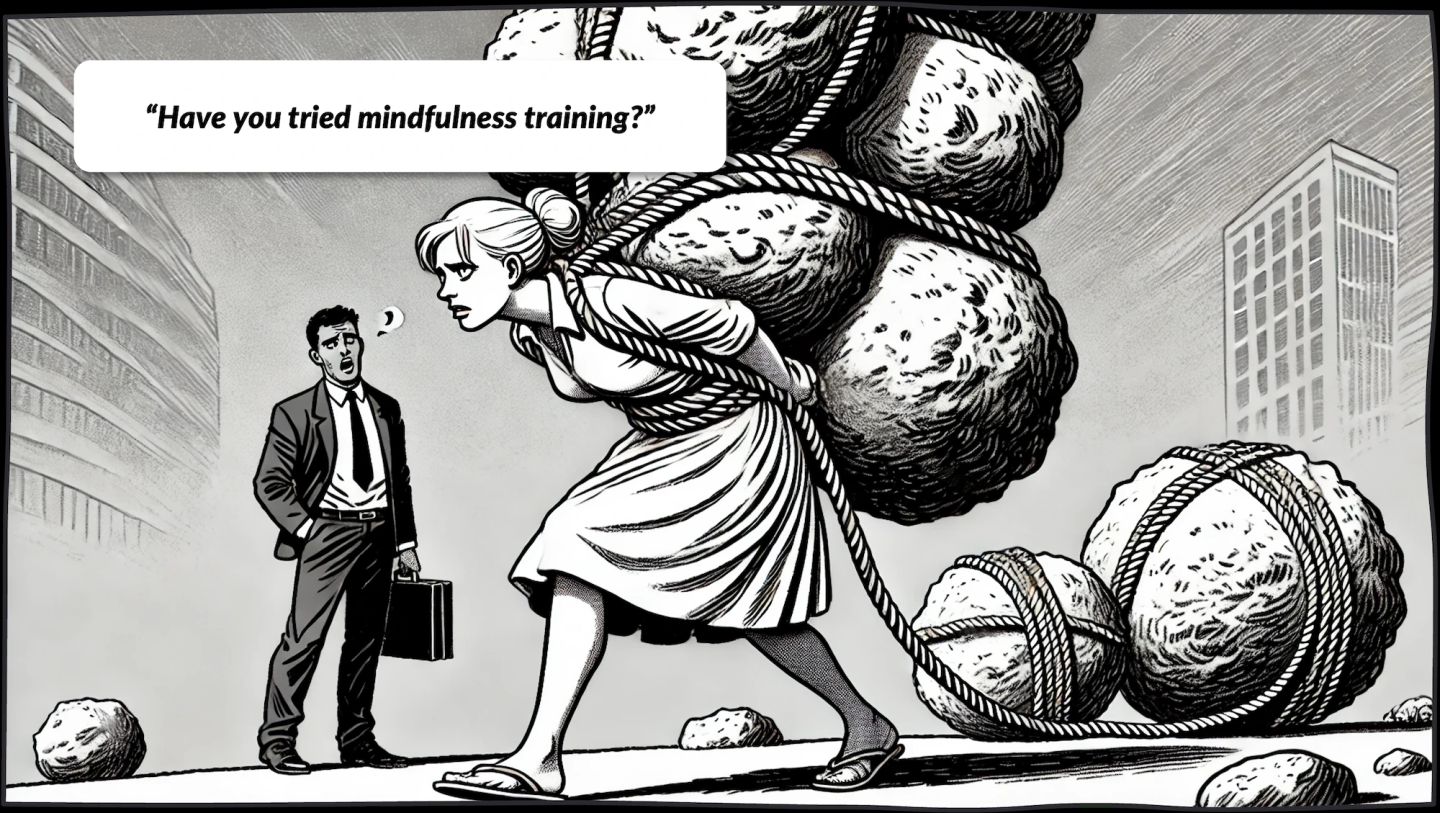
Corporate wellbeing programs are seemingly everywhere. These might include mindfulness training, resilience training, mental health apps, and other variations on the same theme. This is a $20 billion dollar industry that is expected to grow considerably in the next decade.
But what if none of these interventions actually improve wellbeing? That's exactly the conclusion of a recently published study from Oxford University: these wellbeing interventions had no statistically significant benefit - with two minor exceptions:
- Volunteering programs had a small but significant positive impact on wellbeing.
- Resilience, energy, or stress management classes had a small but significant NEGATIVE impact on wellbeing.
This study looked at a number of common workplace mindfulness interventions:
| Intervention | Percent of companies who offer the intervention | Percent of employees who used the intervention |
| Volunteering / charity work | 34% | 41% |
| Mindfulness classes or programmes | 22% | 33% |
| Resilience, energy or stress management classes | 17% | 26% |
| Well-being app for physical health, mental health and lifestyle issues | 12% | 24% |
| Massage or relaxation classes or programmes | 16% | 24% |
| Workload or time management training | 17% | 13% |
| Financial well-being courses | 14% | 10% |
| Events promoting healthy sleep | 4% | 27% |
| Apps promoting healthy sleep | 4% | 25% |
| Well being coaching | 8% | 13% |
| Online coaching | 3% | 14% |
While this research is exceptionally helpful and groundbreaking, let's be honest: the result isn't surprising.
Imagine a demotivating work environment, where colleagues feel a great deal of:
- Emotional pressure (e.g., constantly feeling judged or manipulated)
- Economic pressure (e.g., constantly feeling bullied, coerced)
- Inertia (e.g., having no good reason for doing the job)
These environments are going to make people feel stressed. Suggesting that it's their fault is unlikely to help. In many organizations, these kinds of wellbeing perks have a tinge of "blame the victim" about them.
What causes stress at work?
The same study from Oxford looked at how an organization's structures and processes impact wellbeing. Their findings are instructive.
If the worker:
- Clearly understands their role's expectations
- Has agency on how they do their work
- Is taught the skills needed to succeed
Then their wellbeing is considerably higher.
On the other hand, if the worker:
- Is under unrealistic time pressure
- Has strained working relationships
- Faces discrimination
- Is bullied
Then their wellbeing is considerably lower.
These findings are highly consistent with our own research in Primed to Perform. After studying hundreds of organizations in dozens of industries using both qualitative and quantitative measures, we found that an organization's operating model profoundly impacts employees' motivation (which we view as an accurate measure of wellbeing in a work performance context).
We believe that the negative impact on wellbeing can be traced to three key sources in an organization's operating model.
Source #1: Lack of agency
Which of the following do you think has a larger effect on a person's motivation - having control over where, when, or how they do their work?

Given how much attention has been paid to questions about remote work and workday flexibility since the COVID-19 pandemic, you'd think that when and where take the cake. However, while agency over all three is important, our research actually shows that the biggest impact comes from control over how you work.
The more you understand the science of performance, the more this makes sense. Our research has found that play - meaning a a feeling of genuine curiosity and excitement about one's work - is the number one predictor of high performance, and the most important component of employee motivation. Almost all of play comes down to "how" questions.
Sources #2 and #3: Rushing and repetition
It doesn't take a study to know that employees feel a lot of time pressure - just start a mental count for the word "busy" at the start of any meeting. But here's one anyway: according to Pew Research, 29% of American workers report always feeling rushed, with another 57% feeling rushed at least some of the time. That means that just 14% of employees feel like their work is always moving at an appropriate pace. And the negative effects of time pressure on performance and stress are well-established.
What if you're not only speeding to get things done, but those things aren't particularly interesting? Novelty and complexity are crucial for play, the most important motivator for high performance. If your work is repetitive or simple, it's hard to imagine you'll feel much curiosity. And that's exactly what our research has found.
Put boring work together with time pressure and you have a recipe for motivational disaster:

The problem with wellbeing at work is not employee mindsets; it's organizational operating models. If you can't control how you work, the work isn't interesting, and/or you have to rush your way through it much of the time, you're going to feel stressed. At that point, giving employees mindfulness training is like handing aspirin to a patient with a broken leg: maybe it helps a little, but it's not fixing their problem.
To solve for wellbeing, organizations should invest less in expensive and non-scalable "blame the victim" perks and instead invest more in addressing the root causes of bad performance cultures.
In other words, don't blame the player. Blame the game.
What can I do now to sustainably improve wellbeing at work?
Our research and work is focused on building high-performing cultures in organizations. You can read more of our research or use our tools yourself by visiting us at factor.ai. In the meantime, here are the four most powerful levers you can pull that will increase motivation, performance, and well-being right now.
Prioritization and Strategy
In our work across hundreds of organizations, most teams don't manage their time well. Their team operating model is built to be reactive (hopping from one fire drill to the next), or inertia-driven (just doing the same thing every day without much critical thinking or change). These teams typically have low levels of motivation because they are either highly stressed or uninspired.
In either case, you can fix it by being strategic.
For many leaders, the word "strategy" seems highfalutin (which is ironically a silly word that means "pompous"). But really, "strategy" just means acknowledging that time is valuable, and therefore prioritizing well.
Your organization's operating model should require every team to have a strategy that is always up-to-date. That strategy should be comprised of clear weekly priorities. Moreover, that strategy should ensure that the team's priorities are reasonable within their expected time.
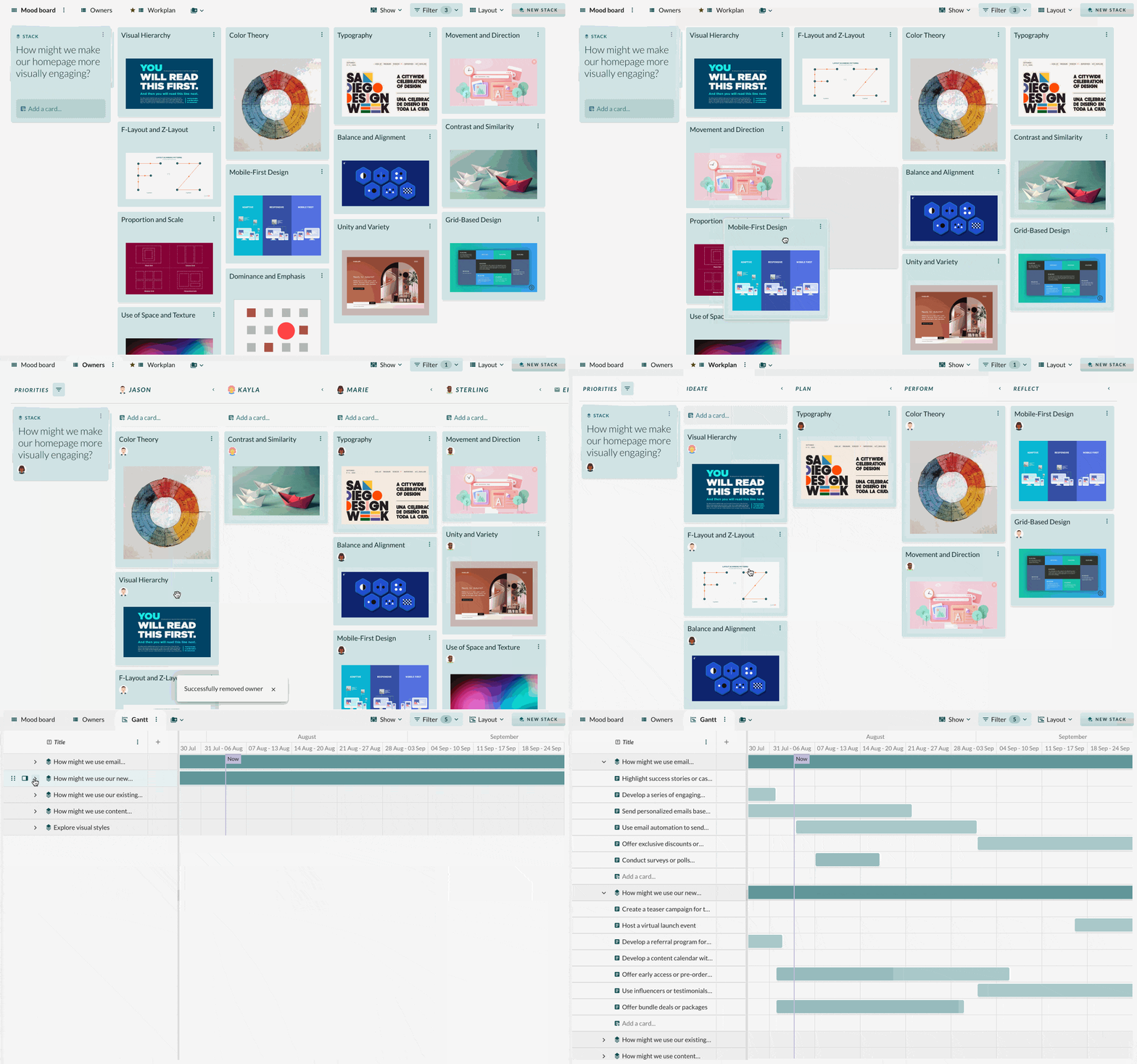
The easiest way to manage a strategy-based operating model is to have each team manage a strategy board that it uses in its meetings every week. A Factor strategy board lists all the priorities of the team (in rank order) along with all the ideas the team is pursuing to achieve its goals.

When an organization uses strategy boards, motivation and performance increase - especially for high performers.
Problem-solving orientation
We've studied motivation and the science of performance for over two decades. Now, when I lead a team myself, one of the most important goals I have is for each of my team members to have at least one impactful idea each week. By mid week, if I notice a colleague hasn't had a useful idea, I try to improve their understanding of a problem they could be solving.
This leadership hack is a powerful and simple way to increase a team's motivation. By ensuring every colleague is engaged in solving some kind of important performance problem, they will feel a much deeper sense of play, purpose, and potential (the three most powerful motivators).
To scale this concept beyond a team, your organization's operating model should be focused on continuous problem solving. There are two important ways to foster a problem-solving culture.
First, you need to teach your whole organization how to collaboratively solve problems. This skill is rarely taught anywhere. However, now having taught tens of thousands of people the skills of problem solving myself, I can attest that this is a simple, low cost, high-ROI lever.
Second, manage problem solving inclusively, transparently, and within structure. For example, we use Factor to organize the problems everyone is solving, so it is much easier for leaders to coach their people. Moreover, Factor uses artificial intelligence to help colleagues structure their problems and generate ideas.
By embracing a problem solving culture, performance and motivation will skyrocket.
Coaching and Apprenticeship
Imagine two dimensions of an organization's operating model:
| Do we exit colleagues who cannot succeed? | |||
|---|---|---|---|
| No | Yes | ||
| Do we challenge, coach, and apprentice colleagues so they grow their skills fast? | No | Lowest-performing. The org is filled with people who are languishing. | Colleagues routinely feel blame and pressure. These cultures are unlikely to increase talent because talent doesn't want to work in a blame-based culture. |
| Yes | Colleagues who cannot perform even with great coaching, apprenticeship, and a high-tomo culture stay in the organization. High performer motivation decreases due to the extra burden on them. | High-performing organizations. These organizations strive to make everyone a high performer through performance coaching and apprenticeship, while those who aren't ready are helped to find jobs that fit them better. | |
Many organizations focus most of their energy on figuring out who to fire. However, many of these same organizations do very little to coach and apprentice their colleagues. These blame-based cultures are extremely stressful, and over time they struggle to attract and retain top talent.
Instead of leaving learning to chance, organizations should build high-accountability apprenticeship cultures.
In apprenticeship cultures, colleagues are rewarded for proactively learning news skills. Leaders are required to help their teams learn new skills. All of this is managed with metrics and transparency to create real accountability
For example, Factor Skills allows every colleague to set skill learning goals, develop plans, and gather ideas in ways that are motivating, not dreadful (like their annual review).

Apprenticeship cultures are one of the strongest ways to create motivation and wellbeing, and at this point there's no reason to ignore this lever.
Leader expectations and Role clarity
Many organizations don't give their leaders clear expectations (oftentimes, that's because they have no clear expectations of leaders in the first place). Not only is this problematic for the teams who are being led, but also, it's very stressful for the leaders. Without having clear "goal posts", leaders are playing a game with constantly changing rules and objectives. As the burden on leaders increases, their stress increases. As a result, leader burnout is at an all-time high.
There's a simple solution to this challenge: articulate expectations for leadership, and keep them accountable.
Our leadership expectations follow two frameworks: Habits and Skills.
First, leaders have to maintain the performance habits of their team. To make that easy, we clearly define the ten Habits of High-Performing Teams, and we provide tools to help teams self-assess which habits are healthy and which are not.

Second, every leader should have a clear roadmap of skills to learn that will improve their overall capability as managers. These skills evolve as leaders grow from leading individuals, to other leaders, to entire departments or organizations. For example, these are the critical skills for executive leaders:

These skills can habits can be all found in the Factor platform if you want to check them out.
There's no time like now
Burnout is at an all-time high. Motivation and engagement are dropping. As a result, organizations that can't build high-performing cultures will suffer. The next decade of business is going to be wild and aggressive. Prepare yourself by building a high-performing culture now.
We realize that the engineering of high-performing cultures isn't easy. Given that, feel free to email us at lindsayandneel@factor.ai, or schedule a meeting with us so we can help you think through your next steps.
Appendix - analysis of the research on wellbeing
Because the operating model of academia has become so low-tomo (known as "publish or perish"), it isn't uncommon to see cancellation and cobra effects. As a result, we see rampant cheating in academia, including p-hacking and even the fabrication of data. So when we use academic research, we try our best to assess it for credibility.
Overall, we believe this research is credible with a low probability of fraudulent practices.
Is the research susceptible to financial or reputational coercion?
The research concluded that wellness perks don't work. Had the research concluded the opposite, it could have gained the backing of a fairly large industry. Moreover, the conclusion that these perks do work is much more likely to increase media coverage, versus the scant coverage this research received.
In other words, if there was a motive to fabricate a conclusion, the direction of emotional and economic pressure would have led to the opposite conclusion. Therefore, we don't think that this research is tarnished by misaligned incentives.
Is the research high-quality?
The research sample was fairly large (27,919 employees in 143 organizations). Moreover, it didn't seem like there was any unusual cherry picking of the sample. The data itself were collected from a third party that was neutral to this study, which further builds credibility.
Who funded the research?
The research was funded by the Economic and Social Research Council, a UK government agency. This funder doesn't have a strong economic incentive for the research to bias one way or the other. Moreover, the research paper itself reads as neutral.
About the authors
Lindsay McGregor
Meet Lindsay McGregor, the best-selling co-author of Primed to Perform, and co-founder of Factor.ai and Vega Factor. She's on a mission to build organizations that are AI Native & People First, because, let's be honest, who wouldn't want a world where every company thrives and everyone genuinely loves their career?
Lindsay is a hard-working nerd at heart. She holds an MBA from Harvard Business School and an undergraduate degree from Princeton University. A former McKinsey & Company consultant, she's also a New York City Library cardholder and a science fiction enthusiast.
Today, Lindsay isn't just talking about change; she's making the tools and doing the science needed to ensure everybody has great professional lives. It's safe to say, she's making work work better for everyone.
Neel Doshi
Meet Neel Doshi, the best-selling co-author of Primed to Perform, and co-founder of Factor.ai and Vega Factor. He's dedicated his career to a pretty ambitious goal: creating a future where all companies are high-performing because they're AI Native & People First. Think of it as making work so good, people actually look forward to Mondays.
Neel looks at this challenge through the eyes of an engineer. He earned his engineering degree from MIT and his MBA from the Wharton School. A former Partner at McKinsey & Company, he's also a Kentucky Colonel and a graduate of the Bronx High School of Science. Neel takes science-nerd to all new heights.
Currently, Neel is focused on showing the world that through science and AI, every team and company can be extremely motivating and high-performing. No one need be left behind in the march of progress.