How to build a high-performing job culture, in ten pictures
Visualizing the path to Operating Models that maximize performance through higher engagement.
Building a high-performance culture requires mastering ten essential frameworks for organizational health. Total Motivation and the VEGA Loops anchor these frameworks in the science of performance. This AI-Native & People-First approach provides a crash course for leaders to rebuild their operating models for maximum engagement and enterprise-scale impact.



Over the past twenty years, a common operating system has infiltrated many organizations. This system often includes quarterly business reviews, OKRs, culture surveys, annual ratings, comp bands and levels, and siloed functions.
Colleagues spend way too much time in bureaucracy. Rather than focus on performance and impact, these systems focus colleagues on deflecting blame, earning a pat on the head, attaining the next promotion, and then getting out of there. One executive in a hyper-scaling tech company told me that every quarter he spends about a month writing the business review memo, which becomes obsolete only a few weeks later. This isn't performance. It's performance art.
As a result, by many measures, the state of work has gotten worse. Adult stress levels, disengagement, burnout, and quiet quitting, are all trending in the wrong direction. The labor movement is rebounding, and societal unrest is growing.
Companies that don't adapt won't thrive in the next decade. Already businesses face heightened volatility in practically every relevant way. Technology, geopolitics, climate, competition, and consumer tastes have all become more volatile.
To build companies that can thrive in the future of work, leaders must learn only ten key frameworks:
- Performance: Organizations need to maximize tactical and adaptive performance, not just one or the other.
- Motivation: To maximize performance, organizations need to increase each colleague’s play, purpose, and potential while reducing their emotional pressure, economic pressure and inertia.
- The symptoms of low-performing cultures: Low motivation organizations destroy performance through distraction, cancellation, and cobra effects.
- Operating model: An organization’s operating model has five critical elements that must be evolved together: vision & strategy, structure & roles, performance cadences, habit-based leadership, and skill-based talent system.
- Vision & strategy: Vision and strategy are like the thesis that explains the why, what, and how of your organization’s target.
- Structure & roles: An org structure is really two parallel structures that must be managed together: reporting lines to help cultivate talent, and teams to do the work.
- Performance cadences: Performance cadences shouldn't be about annual ratings. Instead it should be focused on the daily, weekly, and quarterly cadences that drive the inputs of performance holistically.
- Habit-based leadership: Great leaders create intensity not pressure. Intensity comes from leaders using the right habits to drive the team. Pressure comes from creating blame and shame.
- Skill-based talent system: The employee lifecycle is managed by the talent system. A great talent system doesn’t focus colleagues on jumping through meaningless hoops (e.g., ratings, promotions, bands, and levels). Instead, a great talent system focuses on improving the skill of the organization with bias-free, blame-free meritocracies.
- Play profiles: Rather than focus on low-value personality tests, learn what working style each colleague needs at the current moment to do their best work.
By learning and applying these frameworks, any organization can improve performance sustainably.
Diagnose your organization's performance culture

Great organizations don't settle for either tactical (e.g., process) or adaptive (e.g., problem solving) performance. They seek to maximize both rather than allow one to destroy the other.
- Tactical performance is focused on centralization, strategy, and process.
- Adaptive performance is focused on decentralization, problem solving, and skill.
Scale comes from tactical performance. Growth and innovation come from adaptive performance. Every role, team, and business unit needs to balance both for peak performance.
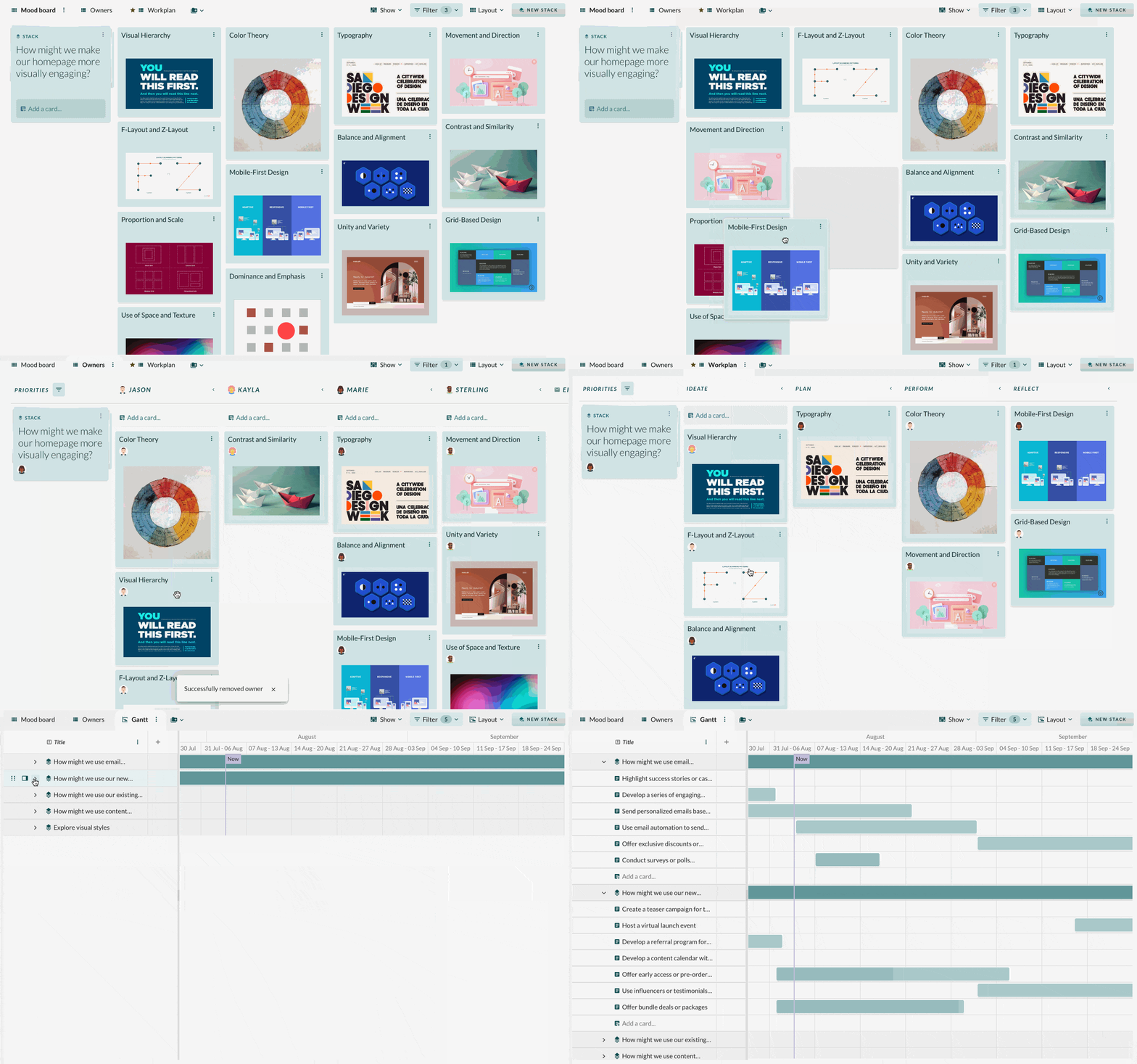
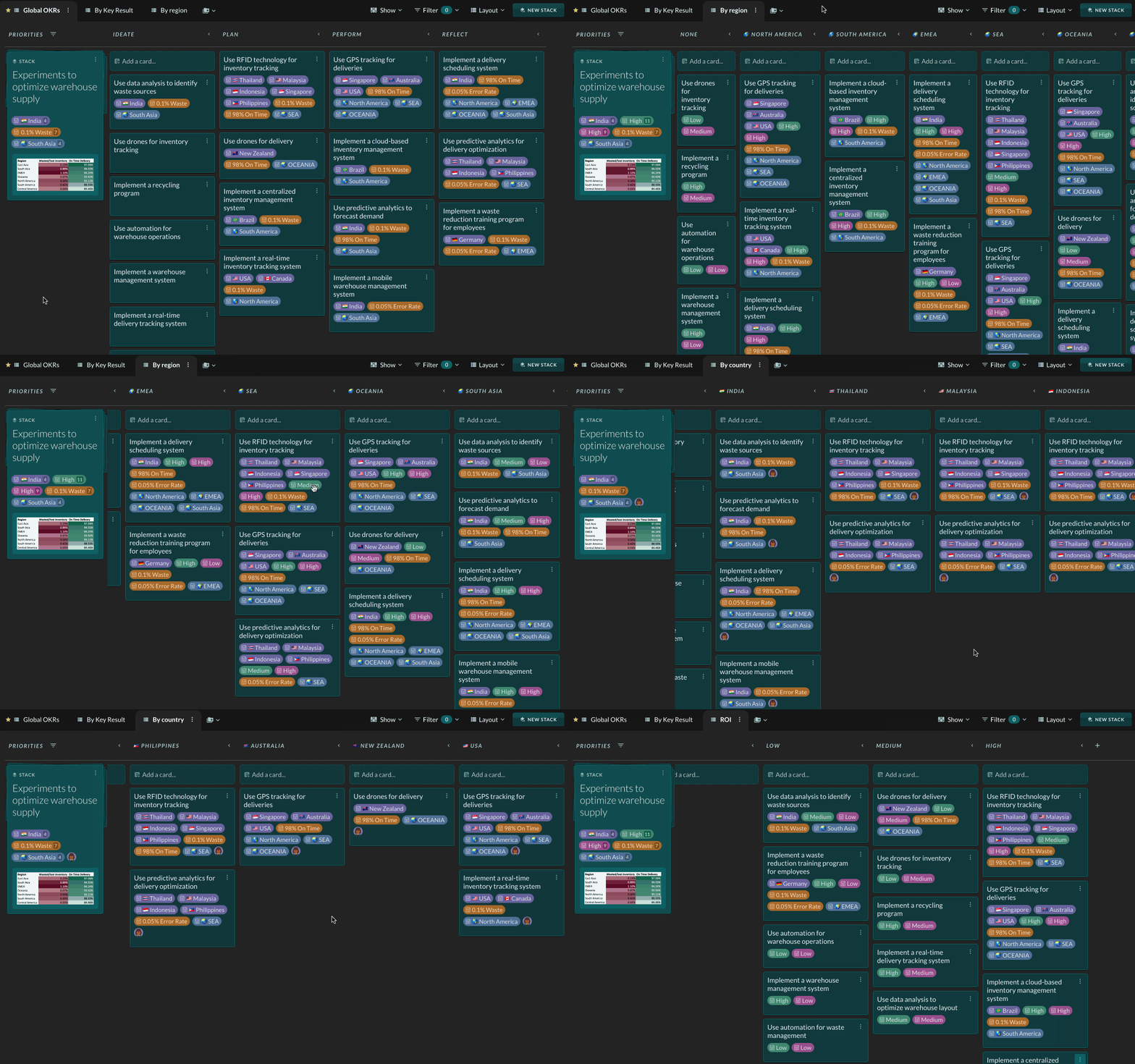
One of the best ways best balance tactical and adaptive performance is to make sure each team has a dynamic priority board.
That board should include all of the team’s priorities, problems, goals, processes, and anything else the team prioritizes working on. This includes top-down goals (the tactical) and bottom-up challenges (the adaptive). By consistently maintaining a transparent board, teams make it easier for leaders to coach them, which is crucial for balancing performance.
Discover your total motivation

To sustainably maximize performance, the best companies motivate their people the right way—by maximizing total motivation. This means:
- Maximizing play, purpose, and potential.
- Minimizing emotional pressure, economic pressure, and inertia.
Much has been written on the topic of performance motivation (e.g., book, articles). If you want to bring these concepts to your teams, have them each conduct a quarterly team Culture Check.
With a Factor Culture Check, teams conduct a quarterly 90-minute discussion. In the first ten minutes of that meeting, they each individually take a brief diagnostic survey that measures team motivation. The team then gets a report that guides them on how to improve their performance culture.
Here is the first page of a sample Culture Check from a multilingual, remote team. The hypotheses are generated by Factor AI to help the team focus on how to improve:

The performance & motivation connection

When an organization...
- decreases play, purpose, or potential...
- or increases emotional pressure, economic pressure, or inertia...
…motivation will decrease. This ultimately results in:
- Distraction effects, like stage fright, where low-tomo pressure prevents effective problem solving.
- Cancellation effects, like quiet quitting or check-the-box behavior where low-tomo environments cause people to focus on just the bare minimum.
- Cobra effects, like cheating or gaming the system, where extreme pressure causes maladaptive performance.
To ensure that an organization is adapting effectively, it isn’t enough for leaders to monitor metrics. They need to engage in the realtime problem solving that their teams do.
When teams use Factor to organize their problem solving, Factor’s News application makes it effective (and, daresay, fun!) to coach colleagues on their problem solving in the right ways and at the the right times.

Operating models create motivation

To perform at the highest levels, an organization must maximize both tactical and adaptive performance. The only way to do that is to also maximize total motivation. The means by which an organization maximizes performance and motivation is their operating model.

Executives must build and maintain a high-performance operating model, which comprises five components representing the different altitudes of an organization:
- Vision & strategy
- Structure & roles
- Performance cadences
- Habit-based leadership
- Skill-based talent system
Vision & strategy set the north star

Your people cannot be high-performing if they don't understand where they are heading and how we think we'll get there. This requires clear vision and strategy.
Many organizations mistake a vision with a mission and values statement. For the most part these statements do not add much value.
Instead, a vision is a growth thesis that explains the chart you see above. It explains the destination of the organization (the what) and why it is important for your customers (the why). And it explains the path we believe we will take to get there (the how).
A good vision is an evolving perspective. It should be top of mind for your people. But too often, an organization's vision gets buried and is seldom referred to.
To solve this in Factor, include the relevant visions as mirrored cards on the top of each colleague’s personal Factor board. In Factor, you can mirror the same cards to many places so that critical information is never out of sight. Colleagues can then easily discuss important topics, like the company’s - or even their role’s - vision, with other colleagues as relevant.

Structure & roles create meaningful ownership

Rather than building silos, a good org structure has two separate, parallel structures:
- Reporting lines should be built to cultivate talent. Their primary purpose should be for talent management, which includes coaching and skill development. As a result, reporting lines should be based on skill families (e.g., sales, marketing, design, product, engineering, etc.).
- Teams should be constructed to manage work. The team-based org structure should be designed around end-to-end missions, comprising the right group of people, even if cross-functional.
While these two structures might be very similar in some parts of the organization, they could be quite different in other parts.
You can use the Factor platform to model and manage both teams and reporting lines in parallel. This allows leaders to properly coach each other while also allowing cross-functional teams (i.e., pods, squads) to perform at high levels.

Performance cadences maintain the drumbeat

Often, organizations think of performance management as narrow and high-pressure (e.g., annual ratings), or time-consuming and bureaucratic (e.g., OKRs and business reviews). In neither case is performance managed well.
Great performance management/cadence is when teams continuously—as in every day—manage the inputs of performance. Those inputs can be explained as the why, the what, and the how.
The why is total motivation.
The what is driven by:
- Tactical performance: strategy (i.e., working backward from your future state). Strategy is tactical because it aims to create focus and convergence.
- Adaptive performance: problem solving (i.e., working forward from your current state). Problem solving is adaptive because it is what teams must do when the strategy isn’t quite right.
The how is driven by:
- Process. Process creates tactical performance by creating a common blueprint for the most common, repeated actions that colleagues take in your organization to produce impact.
- Skill. Skill creates adaptive performance by enabling colleagues to deviate intelligently from process when appropriate, or to solve problems when there is no appropriate process for the challenge at hand.
Factor's priority boards make it easy for teams to manage all forms of performance management in one place, ensuring that they are always balanced and holistic.
Habit-based leadership gives every leader a playbook

High-performing leaders drive their teams with intensity, not pressure. A great leader is like the drum beater in a marching band, keeping teams on track with habits that promote growth.
No team and no leader is perfect. Teams continually change, and their context is volatile. Maintaining good habits can be hard, and teams often become chaotic.
As shared above, Factor Culture Checks are a powerful tool for teams to take ownership over their performance culture. With a Factor Culture Check, teams have a quarterly 90-minute discussion. In the first ten minutes of that meeting, they each individually take a brief Culture Check diagnostic survey that helps them assess their team’s habits. Teams then get a report that guides them on how to improve their habits over the next few months.

Skill-based talent systems make apprenticeship easy and fun

The talent systems of many organizations are biased, unfair, and focus colleagues on jumping through hoops instead of delivering impact. High-performing organizations have skill-based talent systems to drive growth, create meritocracy, and minimize bias.
Nine out of every ten managers feel like their organization doesn’t have the skills it needs to succeed. AI is only causing this trend to worsen as new skills are born and old skills become obsolete.
Factor’s Skills application helps organizations run skill-based talent systems. Colleagues can work with the leaders (with an AI co-pilot) to help select skill goals, plan on-the-job experiments to learn, and claim endorsements.

Play profiles match colleagues to work
Not only are "personality tests" often based on dubious science, but also, they are not built to create high-performing organizations. Typically, the implication of personality testing at work suggests that people should not try to change or grow in ways that will help them perform better. Moreover, they don't give leaders important tools or insights to make adjustments to support the team.
Instead, companies should use Play Profiles to help them adjust their team's habits to increase motivation and performance.
The VEGA model of Play Profiles simply asks two questions that are about your current work preferences - NOT your personality:

The Factor platform not only makes it easy to use Play Profiles to improve team culture, but it embeds play profiles in every experience. Factor makes it top of mind to create the conditions where colleagues can perform.

In closing
This article is meant to simply be a crash course on the cutting edge science of performance. If you're a leader who is working to build a high-performing team or company, there are many more tools at your disposal:
- Read the bestseller, Primed to Perform, to learn more about the science of performance and motivation.
- Use Factor with your team to organize all of the team's work.
- Reach out to a Vega coach to help your team learn how to manage their own performance, motivation, and problem solving.
Share this article and the rest of our research with your colleagues to start their learning journey.
About the authors
Lindsay McGregor
Meet Lindsay McGregor, the best-selling co-author of Primed to Perform, and co-founder of Factor.ai and Vega Factor. She's on a mission to build organizations that are AI Native & People First, because, let's be honest, who wouldn't want a world where every company thrives and everyone genuinely loves their career?
Lindsay is a hard-working nerd at heart. She holds an MBA from Harvard Business School and an undergraduate degree from Princeton University. A former McKinsey & Company consultant, she's also a New York City Library cardholder and a science fiction enthusiast.
Today, Lindsay isn't just talking about change; she's making the tools and doing the science needed to ensure everybody has great professional lives. It's safe to say, she's making work work better for everyone.
Neel Doshi
Meet Neel Doshi, the best-selling co-author of Primed to Perform, and co-founder of Factor.ai and Vega Factor. He's dedicated his career to a pretty ambitious goal: creating a future where all companies are high-performing because they're AI Native & People First. Think of it as making work so good, people actually look forward to Mondays.
Neel looks at this challenge through the eyes of an engineer. He earned his engineering degree from MIT and his MBA from the Wharton School. A former Partner at McKinsey & Company, he's also a Kentucky Colonel and a graduate of the Bronx High School of Science. Neel takes science-nerd to all new heights.
Currently, Neel is focused on showing the world that through science and AI, every team and company can be extremely motivating and high-performing. No one need be left behind in the march of progress.